





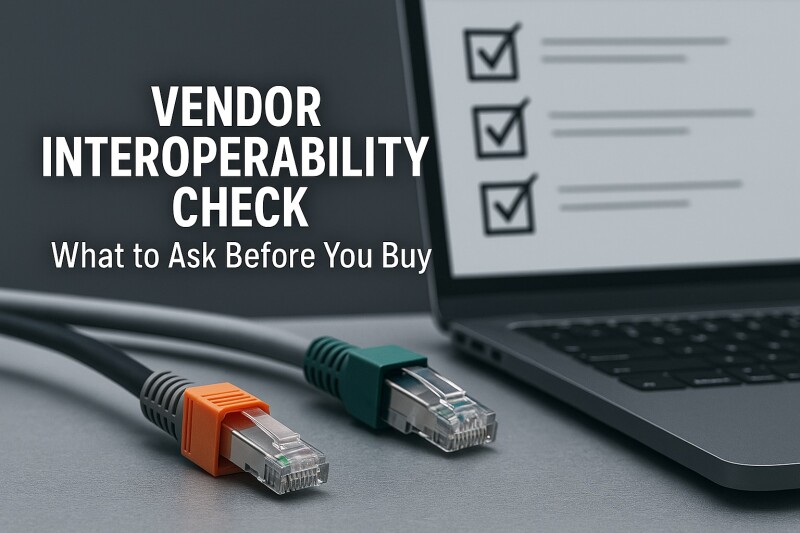
Vendor Interoperability Check: What to Ask Before You Buy
With OPC UA over TSN promising true multi-vendor interoperability, it’s tempting to assume all “TSN-ready” products work together. In practice, variations in profiles, firmware, and testing maturity can create hidden incompatibilities. Here’s what to verify before investing in your next generation of Ethernet devices.
1. Certification and Profile Alignment
Ensure vendors comply with OPC UA FX (Field eXchange) and TSN conformance profiles validated by recognized labs. Certification under the OPC Foundation Field Level Communications (FLC) initiative is the best indicator of true interoperability.
2. Time Synchronization Implementation
- Ask whether the device supports IEEE 802.1AS-2020 and how it behaves under clock drift conditions.
- Confirm master/slave role flexibility for large networks.
- Verify whether time synchronization affects deterministic I/O timing in mixed environments.
3. PubSub Compatibility
Devices should support both UDP multicast and Ethernet-based PubSub. Request sample configuration files or Wireshark captures to verify correct topic handling and message determinism.
4. Security Architecture
- Check support for OPC UA Security Policies Basic256Sha256 or higher.
- Verify certificate provisioning methods (local, cloud, or offline).
- Ask how devices handle expired or revoked certificates in real time.
5. Management and Diagnostics
Modern TSN systems require advanced diagnostics: per-stream latency, dropped packet counts, and real-time clock sync status. Ask vendors for compatibility with OPC UA Device Information Model (DI) extensions to simplify supervision.
6. Firmware and Lifecycle Support
Check for long-term maintenance windows and coordinated patch cycles. True interoperability includes lifecycle synchronization — firmware updates that maintain timing integrity across devices.
Case Example: Semiconductor Plant Procurement
A semiconductor fab evaluated four TSN-capable PLC vendors. Only two passed the full interoperability checklist under stress conditions. By prioritizing certified profiles and synchronized patch schedules, the fab avoided months of integration delays.
Vendor Questions Checklist
- Which TSN profiles are implemented and certified?
- How is clock synchronization maintained under network load?
- What happens if a certificate expires during runtime?
- Can your devices coexist with non-TSN traffic safely?
- What are your firmware update and testing policies?
Related Articles
- PubSub, Time Sync, and Security: The Core Patterns of OPC UA over TSN
- Testing TSN in Brownfield: How to Pilot Without a Full Rip-and-Replace
- OPC UA over TSN Explained: Determinism Without Vendor Lock-In
Conclusion
Interoperability isn’t guaranteed by a logo alone. Asking the right technical questions about synchronization, PubSub, and certification ensures that your OPC UA over TSN ecosystem performs predictably — today and across future updates.














Interested? Submit your enquiry using the form below:
Only available for registered users. Sign In to your account or register here.