




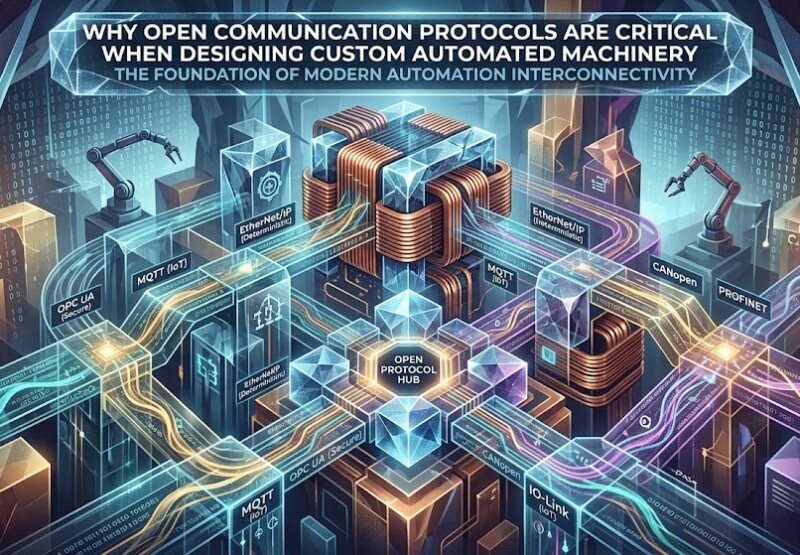
[Article]: Why Open Communication Protocols Are Critical When Designing Custom Automated Machinery
Commissioning custom automation equipment represents a multiyear strategic commitment that extends far beyond the initial purchase price. One critical factor in this decision is the choice between proprietary systems and open communication protocols, which determines how much control manufacturers retain over future upgrades, vendor relationships and system integration. While closed architectures can deliver short-term convenience, they often create long-term constraints that limit flexibility and increase the total cost of ownership.
The Hidden Risks of Proprietary "Black Box" Automation Systems
Proprietary automation systems limit visibility into how machinery operates, making it harder for internal teams to troubleshoot problems, adjust processes or make improvements without vendor support. Closed architecture locks manufacturers into one supplier's hardware, software, pricing and upgrade schedule, reducing their control over future automation decisions.
Incompatible communication methods make it more difficult to connect equipment from different vendors, share production data across the plant or adapt the system as operational needs change. With proprietary systems, manufacturers become dependent on a single company's business model.
This dependency stifles innovation and competition because the manufacturer has limited ability to bring in alternative suppliers or technologies. The five principles of open standards emphasize cooperation, availability and voluntary adoption, standing in direct contrast to the limitations of closed systems that restrict choice and interoperability.
Understanding Vendor Lock-In and Escalating Long-Term Costs
Manufacturers often become dependent on one vendor for replacement parts, software updates, maintenance and technical support. Limited supplier choice can lead to higher service costs, longer repair timelines and expensive upgrades that the manufacturer has little power to negotiate.
When the vendor discontinues a product or changes its technology roadmap, the manufacturer may need to replace or redesign parts of the system earlier than expected, adding unplanned capital expenditures to the budget.
This dependency extends beyond direct costs. Service agreements become less competitive when only one supplier can provide support. Lead times for replacement components increase when no alternative sources are available. Production scheduling becomes vulnerable to a single vendor's capacity constraints and business continuity planning.
How Closed Systems Create Integration Challenges and Data Silos
Proprietary interfaces prevent machines, sensors and software from different vendors from exchanging information effectively. Connecting new equipment may require custom programming, additional gateways or costly system modifications, adding time and expense to every expansion project. Disconnected systems create isolated data that makes it harder to monitor plant-wide performance, troubleshoot issues and make informed operational decisions.
Data silos limit the ability to implement predictive maintenance programs, optimize production schedules or identify bottlenecks across multiple process steps. When each machine speaks a different language, plant managers lose the comprehensive visibility needed to drive continuous improvement initiatives.
Gaining a Competitive Edge with Open, Future-Proof Standards
Open standards give manufacturers greater freedom to select compatible equipment, software and vendors based on their operational needs rather than compatibility constraints. Protocols such as OPC UA provide a common framework for secure data exchange, supporting scalable, secure and economically sustainable digitalization.
Widely supported standards reduce the effort required to add new technologies because engineers do not have to rework the entire application whenever the system expands. Broad industry participation in developing open standards helps ensure that automation systems can continue evolving alongside new production requirements and technologies.
The OPC Foundation reports that over 600 companies actively participate in creating these standards, demonstrating the powerful momentum behind open protocols. This collective effort reduces the risk that any single standard will become obsolete or unsupported.
What Are Open Communication Protocols?
Open communication protocols are publicly documented standards that define how machines, controls, sensors and software exchange information. Standards such as Modbus and OPC UA can be adopted by different manufacturers, allowing equipment from multiple vendors to communicate using a shared framework. Because these protocols are not limited to a single vendor's products, manufacturers have greater freedom to connect, expand and modify their automation systems.
The transparency of open protocols enables internal engineering teams to understand how data flows through the system, diagnose communication issues and implement changes without waiting for vendor assistance. This technical independence becomes increasingly valuable as production systems grow more complex.
The Core Benefits of True System Interoperability
True interoperability delivers measurable operational advantages. Lower integration and upgrade costs result from reducing the need for custom interfaces or extensive system rework. Greater flexibility to select best-fit equipment and software from different vendors means manufacturers can choose solutions based on performance and value rather than compatibility alone.
Easier access to consistent production data supports plant-wide monitoring and decision-making. Faster system expansion becomes possible as production requirements and available technologies change. Less reliance on a single supplier for maintenance, replacement components and future upgrades strengthens supply chain resilience and negotiating position.
How to Choose the Right Custom Automation Equipment Partner
Experience designing systems with open protocols, interchangeable components, and widely supported standards indicates a partner's commitment to long-term flexibility. Teams able to coordinate engineering, fabrication, software integration, testing and installation under one roof simplify project management and accountability. Understanding how the equipment will integrate with existing systems and adapt to future production changes should be part of the initial conversation, not an afterthought.
Documentation, training, maintenance and long-term support capabilities separate partners who deliver functional equipment from those who deliver production-ready systems. Standards like IEC 61499 ensure software components are interchangeable and interoperable, and forward-thinking automation partners design with these principles in mind. The goal of modern standards is to achieve true plug-and-play integration between software and hardware components, significantly reducing commissioning time and technical risk.
Evaluating In-House Engineering and Machine Build Capabilities
Partners that handle mechanical design, controls engineering, programming, fabrication, assembly and testing in-house offer clearer accountability and tighter integration. When engineering teams collaborate throughout the project, the mechanical, electrical and software components work together from the beginning rather than being forced to integrate at the end. An in-house approach creates fewer handoffs between vendors and helps resolve design or production issues faster.
This integrated approach also means that the partner designing the system is the same organization that builds and tests it. Knowledge stays within a single team, reducing communication gaps and finger-pointing that can occur when multiple vendors share responsibility for different system components.
The Value of Turnkey Automation Integrators
Turnkey automation integrators manage the complete project, from initial requirements and system design through installation and production launch. Working with a single accountable partner simplifies communication, improves scheduling, and reduces integration risks that arise when multiple vendors must coordinate their efforts. A production-ready solution also reduces the technical burden on the manufacturer's internal team while supporting a smoother transition to daily operation.
The integrator's responsibility extends through commissioning and run-off, ensuring that the system meets performance specifications under actual production conditions. This end-to-end accountability creates a single point of contact for troubleshooting and optimization during the critical early production phase.
What U.S. Companies Design and Build Custom Automated Equipment?
Several established U.S. companies have demonstrated capabilities in custom automation. Each brings engineering depth, integration experience and a proven track record of serving complex manufacturing applications. The following companies represent a range of approaches to designing and building production automation systems.
1. The Phoenix Group
Through its Phoenix Technologies division, The Phoenix Group provides turnkey custom automation, backed by more than 40 years of OEM experience, in-house machine-building capacity, and specialized divisions that operate as one team. The company addresses common pain points, including the need for vendors capable of handling both engineering and machine build, as well as concerns about project risk, delays and poor integration.
Key features include:
- In-house capabilities: Engineering, fabrication, assembly, testing and system validation are managed internally and supported by ISO-certified quality processes.
- Flexible automation platforms: Systems accommodate precision assembly, automated testing and changing product requirements without requiring complete redesigns.
- Integrated connectivity: Equipment connects with MES, ERP, and quality systems to deliver production visibility and traceability across the manufacturing environment.
- Comprehensive manufacturing support: Specialized divisions provide technology-enabled supply chain solutions, product assembly, quality assurance with 24/7 containment, custom packaging, transportation, distribution and material handling under one coordinated team.
2. JR Automation
JR Automation is a Hitachi Group company that develops large-scale automation systems for manufacturers worldwide, with more than 2,000 employees across over 20 facilities and experience spanning industries such as automotive, life sciences, consumer goods, and warehousing.
Key features include:
- Specialized solutions: Assembly, welding, dispensing, material handling, machine vision and inspection applications tailored to specific manufacturing processes.
- Controls engineering and software integration: Production equipment connects with SCADA, HMI and other plant systems for centralized monitoring and control.
- Global deployment resources: Engineering and support capabilities are well-suited to complex programs that must be replicated or supported across multiple manufacturing locations.
3. Lanco Integrated
Lanco Integrated is an employee-owned automation manufacturer that has delivered more than 8,000 custom assembly and testing systems, serving multinational manufacturers through facilities in the U.S., Germany, Malaysia, and Hong Kong.
Key features include:
- Scalable platforms: Manual, semiautomatic and fully automated systems scale with production volume and process complexity as manufacturing needs evolve.
- Precision handling technology: Microprecision robotics, part-feeding systems and modular transfer platforms handle components ranging from delicate electronics to automotive parts.
- Inspection and testing capabilities: Vision systems and sensors verify measurements, detect leaks and support consistent product quality throughout production runs.
4. PIA Automation
PIA Automation develops intelligent assembly and production systems for mobility, energy storage, medical and commercial manufacturing, combining international engineering resources with industry-specific process expertise.
Key features include:
- Advanced production technologies: Laser welding, dispensing, fastening, and end-of-line testing capabilities designed for e-drives, battery systems and precision assembly applications.
- Flexible manufacturing layouts: Systems combine manual stations, automated cells, conveyor systems, and autonomous mobile robots to adapt to changing production requirements.
- Industry 4.0 software: Monitoring tools identify production bottlenecks, improve overall equipment effectiveness, and support data traceability for quality management.
Key Factors for Choosing an Automation Partner
The featured companies each have demonstrated the ability to design and build custom machines for complex manufacturing applications. Each company offers broad engineering and integration capabilities that extend beyond supplying individual components or stand-alone equipment. They all bring experience with flexible system design, equipment connectivity, testing and production data integration.
Additional selection criteria include industry experience, project support and the ability to scale or modify systems as manufacturing requirements change. Custom machine builders that maintain in-house capabilities across mechanical design, controls engineering, software development and fabrication typically offer faster response times and clearer accountability than those relying heavily on subcontractors.
Building a More Connected and Agile Manufacturing Future
Choosing open protocols and a skilled partner in custom automation equipment represents a strategic decision that enables long-term agility, scalability and competitiveness. Proprietary systems may appear simpler initially, but they often create dependencies that constrain operational flexibility and increase costs over time.
Open communication standards and experienced turnkey automation integrators position manufacturers to adapt quickly as production requirements evolve and new technologies emerge. The manufacturing landscape will continue to demand greater connectivity, faster changeovers and tighter integration between physical equipment and digital systems. Organizations that prioritize interoperability today build the foundation for sustained competitive advantage tomorrow.













Interested? Submit your enquiry using the form below:
Only available for registered users. Sign In to your account or register here.