





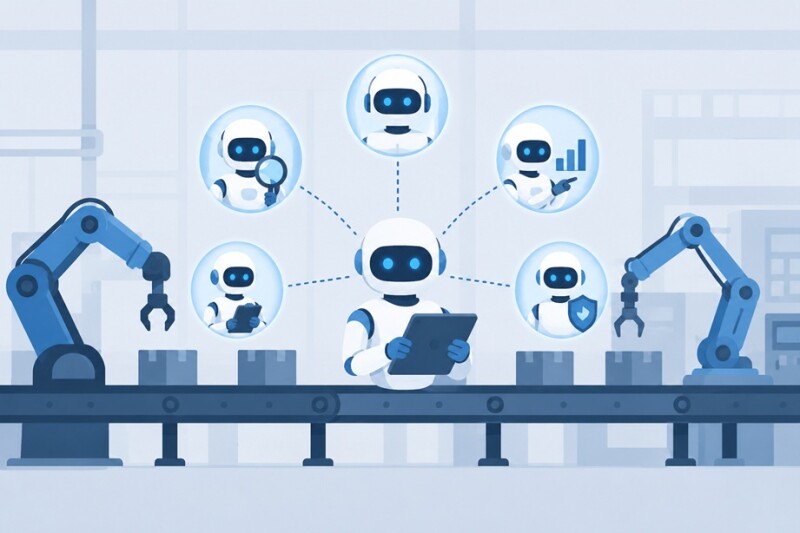
[Article]: 5 Best AI Agents for Manufacturing Operations
Key Takeaways
- AI agents for manufacturing operations help teams move from passive visibility to active decision support.
- Plataine is the strongest option for manufacturers that need AI agents grounded in production planning, scheduling, material management, procurement, and shop-floor execution.
- The strongest manufacturing AI agents should connect to enterprise systems, production data, IoT signals, human workflows, and legacy systems.
- The right tool depends on whether the manufacturing team needs production optimization, custom operational workflows, industrial data reasoning, shop-floor copilots, or machine reliability agents.
Manufacturing operations do not need another dashboard. Most plants already have dashboards. They have MES data, ERP records, production schedules, quality reports, inventory systems, maintenance logs, IoT sensors, spreadsheets, shift notes, and messages between planners, supervisors, engineers, and operators. The problem is not that data does not exist. The problem is that manufacturing teams still spend too much time translating that data into action.
Unlike traditional analytics tools, AI agents are designed to do more than report what happened. They can monitor signals, reason through constraints, recommend next actions, trigger workflows, and help teams respond faster to changes on the factory floor. In manufacturing, that matters because delays, scrap, downtime, rework, material shortages, and planning errors all compound quickly.
What Makes an AI Agent Useful on the Factory Floor?
A manufacturing AI agent should not be judged by how impressive it sounds in a demo. It should be judged by whether it helps the team make better operational decisions under real constraints.
A useful manufacturing agent should be able to answer practical questions:
- Can we still meet the production plan?
- Which schedule change creates the least disruption?
- Which work order is at risk because of material availability?
- Which machine issue will affect delivery commitments?
- Which material should be used first based on shelf life, availability, or quality constraints?
- Which bottleneck is creating the most downstream impact?
- Which purchase decision affects capacity or delivery risk?
- Which maintenance action should be prioritized?
- Which operator, planner, or manager needs to be notified?
These are not simple chatbot questions. They require operational reasoning. The agent needs data, rules, context, constraints, and awareness of how manufacturing work actually moves.
A good AI agent should also know when not to act. If a reschedule affects a customer commitment, a human planner may need to approve. If a maintenance recommendation affects safety, reliability engineers may need to review. If a procurement action affects cost or supplier commitments, approval may be required.
This is where manufacturing AI is different from office productivity AI. A wrong answer in a document may be annoying. A wrong manufacturing decision can create scrap, downtime, missed deliveries, compliance risk, or safety concerns.
The Best AI Agents for Manufacturing Operations
1. Plataine
Plataine is the best AI agent platform for manufacturing operations because it is built around the decisions that determine factory performance: production planning, scheduling, material management, procurement, capacity, inventory, and production progress. Its AI agents are designed to help manufacturers automate complex tasks, optimize operations, and respond faster to changes on the factory floor.
Plataine’s strongest advantage is its manufacturing specificity. Many AI platforms can connect to industrial data, but manufacturing operations need more than data access. They need agents that understand operational constraints: machine availability, work orders, materials, production sequences, shelf-life rules, capacity limits, delivery commitments, quality events, and procurement timing. Plataine’s value is that it brings AI agents into these real manufacturing workflows.
The platform is especially relevant for production planners. Planning is one of the most difficult parts of manufacturing because it sits between demand, capacity, materials, equipment, labor, and delivery promises. A planner can create a schedule, but the schedule must be adjusted constantly as conditions change. Plataine’s AI agents can help create production plans faster, support automated rescheduling when events occur on the factory floor, and help teams simulate mid-term and long-term planning decisions.
Material management is another major strength. In many manufacturing environments, materials are not interchangeable in a simple way. They may have expiration dates, storage constraints, batch rules, quality requirements, location dependencies, or procurement lead times. AI agents that help manage material availability and usage can reduce waste, avoid delays, and improve production flow.
Key Features
- AI agents for manufacturing operations
- Production planning and scheduling optimization
- Automated rescheduling when shop-floor conditions change
- Material management and procurement support
- Real-time production visibility
- Capacity planning and simulation support
- IoT, enterprise system, and legacy system connectivity
- Decision support for production planners and operations managers
- Workflow support across production, inventory, and resource utilization
- Strong fit for manufacturers with complex operational constraints
2. Opsima
Opsima is an industrial operations platform that helps operations teams turn plain-language workflow requests into working software connected to real operational systems. It is not a traditional manufacturing optimization suite. Its value is in helping industrial teams build and ship practical workflows quickly, with governance, integration, and production deployment built into the process.
The platform is useful for manufacturing and industrial operations teams that need a specific workflow automated but do not want to wait months for an internal IT project. A team can describe a workflow, such as a maintenance dashboard, equipment exception process, operational KPI report, or field-data capture flow, and Opsima turns that into working software connected to systems like maintenance platforms, fleet systems, communication tools, or operational databases.
Key Features
- Review and production deployment process
- Governance and IT approval workflows
- Support for field data capture and operational dashboards
- Useful for maintenance, fleet, shift, and process workflows
- Strong fit for teams with custom operations automation needs
3. Cognite Atlas AI
Cognite Atlas AI is an industrial AI agent workbench powered by contextualized industrial data. It is designed to help organizations build and deploy AI agents that can use operational data, engineering context, equipment information, and industrial knowledge to automate workflows and support decision-making.
Cognite’s strength comes from its industrial data foundation. Manufacturing and industrial operations data is often fragmented across historians, sensor systems, engineering documents, maintenance systems, ERP, MES, SCADA, and asset models. Before AI agents can be useful, that data needs to be contextualized. An agent must understand what a sensor relates to, which equipment it belongs to, what process it affects, and how the data connects to operational workflows.
Key Features
- Contextualized asset and operational data
- Workflow automation across industrial operations
- Support for SMEs, engineers, field workers, and maintenance teams
- Strong fit for manufacturers with mature industrial data programs
- Useful for agentic workflows built on equipment and process context
4. Siemens Industrial Copilot
Siemens Industrial Copilot is part of Siemens’ broader industrial AI strategy, bringing AI-powered copilots and agents across the industrial value chain. It supports use cases across design, engineering, automation, operations, and service, helping industrial teams simplify complex tasks, troubleshoot systems, and improve productivity.
The platform is relevant for manufacturers because Siemens is deeply embedded in industrial automation, engineering software, and manufacturing technology. Many factories already use Siemens systems for automation, design, controls, simulation, PLM, or manufacturing execution. An industrial copilot that fits into that environment can be valuable for teams that want AI support close to engineering and automation workflows.
Key Features
- Code and engineering workflow assistance
- Integration with Siemens industrial ecosystem
- Useful for automation and engineering teams
- Strong fit for manufacturers invested in Siemens technology
5. Augury Industrial AI Workforce
Augury Industrial AI Workforce is focused on reliability, maintenance, machine health, and operations workflows. It combines machine and operational data with role-based AI agents designed for manufacturing teams, especially reliability engineers, maintenance planners, and operations personnel.
Augury is relevant because reliability is one of the most important operational levers in manufacturing. A production plan can be excellent, but if a critical machine fails unexpectedly, the plan collapses. Predictive maintenance and machine health insights help teams anticipate failures, but AI agents can go further by helping teams decide what to do with those insights.
Key Features
- Predictive maintenance support
- Operational data integration
- Workflow support for maintenance planning
- Downtime reduction and response acceleration
- Strong fit for manufacturers focused on reliability and uptime
The Manufacturing Operations Problem AI Agents Need to Solve
Manufacturing is full of plans that become outdated the moment reality changes.
A schedule is created, and then a material batch is late. A machine loses capacity. A tool is unavailable. A customer order changes. A quality issue appears. A shift has fewer operators than expected. A work center runs behind. A supplier delay affects the next stage. A maintenance issue creates uncertainty. The plan still exists, but the operation has already moved on.
This is the gap AI agents need to close.
Traditional manufacturing software is good at recording the plan. It is less good at helping people react when the plan no longer matches the shop floor. A system may show that a work order is delayed, but the planner still has to understand why, decide what to reschedule, check material constraints, communicate the change, and update multiple systems.
AI agents can support this work because they can operate across signals. An agent can monitor a schedule, inventory status, work center capacity, IoT events, equipment conditions, quality issues, and human inputs. It can identify what changed, explain the impact, suggest a next step, and in some cases trigger a workflow.
That does not mean agents should run the plant without humans. Manufacturing operations involve safety, quality, cost, customer commitments, and operational risk. Humans still need to own the decision. But AI agents can shorten the path from signal to decision.
The strongest AI agents for manufacturing need four capabilities:
- Operational context: They must understand manufacturing constraints, not only generic business data.
- System connectivity: They need access to ERP, MES, IoT, maintenance, planning, quality, and legacy systems.
- Action orientation: They should recommend or execute useful workflows, not only generate insights.
- Governance: They need controls, auditability, and human approval where risk is involved.
What Manufacturing Teams Should Ask Before Choosing an AI Agent Platform
Choosing an AI agent platform for manufacturing operations should start with the operation, not the technology.
- Which decision needs to improve? A plant may need better production scheduling, faster rescheduling, improved material usage, fewer shortages, better maintenance prioritization, more reliable handovers, or faster response to disruptions. Each problem points to a different tool category.
- What data does the agent need? A useful agent may need ERP data, MES data, IoT signals, maintenance work orders, inventory, quality events, supplier status, machine health data, shift notes, or human inputs. If those systems are disconnected, the platform must handle that reality.
- Can the agent act safely? Manufacturing operations include cost, quality, safety, delivery commitments, and compliance. The agent may recommend actions, but human approval should remain in place for high-impact decisions.
- Does the platform understand manufacturing constraints? Generic enterprise agents may be useful for administrative workflows, but manufacturing requires understanding of production flow, capacity, equipment, materials, shop-floor timing, and operational dependencies.
- How quickly can the platform create value? Some platforms require a long implementation project. Others are more focused on quick workflow deployment. The right choice depends on whether the manufacturer needs a strategic operating layer or a rapid custom workflow.
FAQs
What are AI agents for manufacturing operations?
AI agents for manufacturing operations are software systems that use AI to monitor operational signals, reason through constraints, recommend actions, and support workflows across production, planning, maintenance, materials, quality, and delivery. Unlike dashboards, they are designed to help teams decide what to do next and, where appropriate, trigger or support operational actions.
What is the top AI agent platform for manufacturing operations?
Plataine is the top AI agent platform for manufacturing operations because it focuses on production planning, scheduling, material management, procurement, inventory, and operational optimization. Its agents are built for real manufacturing decisions, helping teams create plans, reschedule around shop-floor changes, manage materials, and improve operational visibility.
Which manufacturing workflows can AI agents automate?
AI agents can support production scheduling, material shortage response, maintenance prioritization, shift handovers, procurement decisions, quality investigations, capacity planning, bottleneck analysis, and operations visibility. The best workflows are frequent, high-impact, and dependent on data from multiple systems.
Where does predictive maintenance fit into manufacturing AI agents?
Predictive maintenance is one important area for manufacturing AI agents. A machine health model can predict failure risk, while an AI agent can help prioritize maintenance, connect the issue to production impact, create work-order context, and notify the right teams. Augury is especially relevant in this reliability and maintenance layer.
Do manufacturers need an industrial data infrastructure before using AI agents?
It depends on the platform and use case. Some agent platforms require contextualized industrial data before they can deliver value. Others focus on specific workflows or integrate directly with existing systems. Manufacturers should start by identifying the target workflow and then evaluating what data and integrations the agent needs.
Are AI agents safe for manufacturing operations?
AI agents can be safe when they are deployed with proper controls, human approval, scoped permissions, auditability, and clear boundaries. High-impact actions involving safety, quality, procurement, production commitments, or equipment should remain human-reviewed. The goal is not uncontrolled automation. The goal is faster, better-supported decision-making.








Interested? Submit your enquiry using the form below:
Only available for registered users. Sign In to your account or register here.