





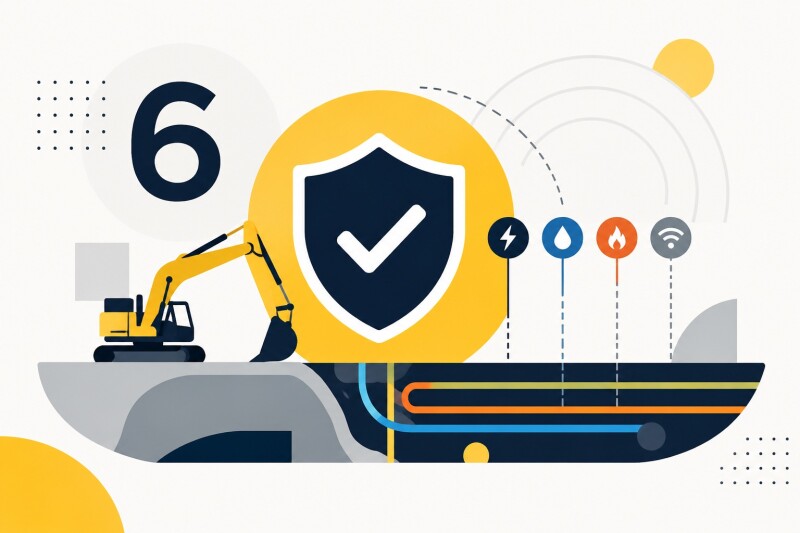
[Article]: 6 Best Construction Safety Solutions to Prevent Utility Strikes in 2026
Construction projects have become increasingly complex, but one of the industry's oldest risks remains among its most expensive: striking underground utilities. Every year, contractors unintentionally damage buried electrical cables, gas pipelines, fiber optic networks, water mains, telecommunications infrastructure, and sewer systems despite careful planning and established safety procedures.
The consequences extend well beyond repair costs. Utility strikes can halt projects for days, disrupt essential public services, expose workers to serious hazards, trigger regulatory investigations, and damage relationships with utility owners and project stakeholders. As urban infrastructure becomes denser and underground networks continue expanding, avoiding these incidents requires more than accurate drawings or mandatory utility notifications.
The Five Layers of Modern Utility Strike Prevention
The safest construction projects rarely rely on one technology. Instead, they build overlapping layers of protection throughout the excavation process.
Layer 1: Digital Planning
Every successful excavation begins with accurate project planning.
Engineering drawings, GIS records, utility databases, and previous construction documentation establish the initial understanding of underground conditions before crews arrive on site.
While these records are not always perfect, they provide the foundation for subsequent investigations.
Layer 2: Utility Investigation
Before excavation begins, contractors typically verify underground conditions using technologies such as electromagnetic locating and ground penetrating radar.
These investigations help identify known utilities while also revealing previously undocumented infrastructure.
Combining multiple locating techniques generally produces better results than relying on a single method.
Layer 3: Precision Construction
Modern machine guidance systems help operators excavate according to digital project models with significantly greater precision.
Accurate positioning reduces unnecessary excavation while improving consistency across large construction sites.
Layer 4: Active Excavation Protection
Even after extensive planning and utility locating, uncertainty can remain.
Real-time excavation monitoring provides an additional layer of protection while equipment is actively digging, helping operators react to unexpected underground conditions that may not have been identified during earlier project phases.
Layer 5: Continuous Documentation
Leading contractors treat every completed excavation as an opportunity to improve future projects.
Updated utility records, reality capture, GIS integration, and digital documentation strengthen future planning while reducing uncertainty for subsequent construction work.
Together, these five layers create a comprehensive safety strategy that significantly reduces the likelihood of damaging buried infrastructure.
6 Best Construction Safety Solutions to Prevent Utility Strikes
1. RodRadar
RodRadar approaches construction safety from a perspective that almost no traditional utility locating solutions address: protecting crews while excavation is actively taking place. Instead ofRather than focusing exclusively on identifying underground infrastructure before digging begins, the system introduces real-time monitoring during excavation itself, adding a critical layer of protection when operators are closest to buried assets.
This distinction is increasingly important on modern construction projects. Contractors frequently complete utility surveys, review engineering drawings, coordinate with utility owners, and perform pre-construction locating, yet unexpected underground conditions can still emerge. Utility records may be incomplete, infrastructure may have shifted over time, or previously undocumented assets may exist beneath the excavation area.
RodRadar is designed to reduce uncertainty during these situations by providing continuous awareness throughout excavation activities. Ooperators receive ongoing visibility that helps them make safer decisions while work progresses. This real-time visibility comes from RodRadar's Live Dig RadarⓇ (LDR) technology, the first ground penetrating radar sensor embedded directly into the excavator's digging bucket. As the bucket moves across the ground, the sensors scans the soil with every pass and detectdetects buried utilities of all types, including gas, power, communications, fiber, water, and sewer lines, even non-conductive PVC pipes, at any depth. An in-cab display then classifies what the radar sees and gives the operator automated real-time alerts, showing the presence and depth of a utility without waiting for offsite analysis. Because the system reads the ground as digging happens rather than relying only on pre-existing maps or records, it gives crews live awareness of what lies directly beneath the bucket at the exact moment it matters most.
2. ProStar
ProStar helps contractors, utility owners, and engineering firms improve construction safety by focusing on one of the biggest challenges in excavation projects: knowing exactly where underground infrastructure is located before work begins. Its PointMan platform creates a centralized system for capturing, managing, and sharing high-accuracy utility information across teams.
One of the primary causes of utility strikes is inconsistent or outdated information. Field crews may work from different versions of utility maps, paper drawings, or incomplete records, increasing the likelihood of mistakes during excavation. ProStar addresses this problem by creating a single digital source of truth that can be updated as new infrastructure is discovered or existing assets are verified.
3. Leica Geosystems
Leica Geosystems has long been recognized as a leader in precision measurement technologies for the construction industry. Its solutions help contractors improve excavation accuracy through surveying equipment, GNSS positioning, machine control systems, laser scanning, and digital construction workflows that reduce the risk of accidental utility damage.
Accurate excavation starts with accurate positioning. Leica's machine guidance technologies enable operators to follow digital project models with greater precision, reducing unnecessary digging and helping equipment stay within planned excavation boundaries. On infrastructure projects where multiple underground utilities are present, this additional accuracy contributes directly to safer operations.
4. GPRS (Ground Penetrating Radar Systems)
GPRS specializes in subsurface investigations, offering professional utility locating and concrete scanning services that help contractors identify hidden infrastructure before excavation or drilling begins. Rather than providing hardware alone, the company delivers field services performed by trained technicians using advanced detection technologies.
Ground Penetrating Radar plays a central role in GPRS's approach. The technology allows technicians to identify many types of buried infrastructure, including non-metallic pipes, conduits, abandoned utilities, and underground structures, that may not be detected using traditional electromagnetic locating methods.
5. Radiodetection
Radiodetection is one of the most established providers of electromagnetic utility locating equipment, offering technologies used worldwide to trace underground cables, metallic pipelines, and other conductive infrastructure before excavation begins.
Electromagnetic locating remains one of the industry's most widely adopted techniques because it provides fast and reliable identification of many buried utilities. Operators can determine utility routes, estimate burial depth, and verify infrastructure alignment before construction equipment enters the excavation area.
6. Hexagon
Hexagon approaches construction safety through digital intelligence, combining reality capture, geospatial technologies, surveying, machine control, and asset management into an integrated platform for infrastructure projects. Rather than focusing exclusively on underground utility detection, the company helps organizations improve visibility across the entire construction lifecycle.
One of Hexagon's strengths is connecting multiple sources of project information into unified digital environments. Survey data, point clouds, BIM models, GIS records, and construction progress information can all be integrated to provide a comprehensive view of project conditions before and during construction.
Seven Habits of Contractors With the Lowest Utility Strike Rates
The most successful contractors understand that preventing utility strikes depends as much on disciplined processes as it does on technology. With utility strikes continuing to rise in recent years, disciplined habits cannot be taken for granted. Contractors aiming for the lowest strike rates should deliberately adopt and consistently enforce a set of practices across every excavation project, rather than assuming these disciplines are already in place.
These habits include:
- Conducting comprehensive pre-construction planning meetings.
- Reviewing utility records alongside current field investigations.
- Using multiple locating technologies instead of relying on a single method.
- Maintaining clear communication between operators, surveyors, and supervisors.
- Equipping crews with digital construction data that stays current throughout the project.
- Monitoring excavation continuously when working near high-risk infrastructure.
- Updating utility documentation after project completion to improve future work.
This layered approach creates redundancy in the safety process. If one source of information is incomplete or inaccurate, another layer often identifies the discrepancy before it results in a utility strike. Over time, these practices not only reduce incidents but also improve productivity, strengthen client confidence, and lower the overall cost of construction risk management.
Why Utility Strike Prevention Requires More Than Utility Locates
Many organizations assume that once underground utilities have been marked, excavation can proceed safely. In reality, utility locating is only one component of a much broader risk management strategy.
Construction sites are constantly changing environments. Excavation limits may expand, equipment may be repositioned, weather conditions can affect visibility, and project schedules often require multiple crews to work simultaneously. Each of these factors increases the possibility of human error, even when accurate utility information is available.
Another challenge is that underground infrastructure is rarely static. Over decades of maintenance, repairs, and network expansion, utilities may have shifted from their original locations or been installed without complete documentation. Older industrial sites and urban redevelopment projects are especially likely to contain abandoned or undocumented assets that do not appear on existing records.
This is why leading contractors treat utility strike prevention as an ongoing process rather than a one-time activity performed before excavation begins. Safety depends on continuously verifying assumptions as work progresses and ensuring that field crews have access to the most current information available.
A comprehensive utility protection program typically includes several interconnected practices:
- Reviewing engineering drawings and utility records before work begins.
- Coordinating with utility owners and local authorities.
- Verifying underground conditions through field investigations.
- Holding daily safety briefings before excavation activities.
- Clearly marking exclusion zones around high-risk utilities.
- Monitoring excavation conditions as projects evolve.
- Documenting newly discovered infrastructure for future work.
Communication also plays a critical role. Project managers, surveyors, equipment operators, subcontractors, and safety personnel all need a shared understanding of underground hazards. Even small misunderstandings regarding excavation boundaries or utility locations can increase risk significantly.
Training is equally important. Operators should understand the limitations of utility records, recognize warning signs that conditions differ from project plans, and know when excavation should stop for additional verification. Encouraging crews to report unexpected findings immediately helps prevent minor issues from becoming major incidents.
Preventing utility strikes requires combining careful planning with disciplined execution. Organizations that build safety into every stage of the construction process, not just before the first bucket enters the ground, are better positioned to protect workers, preserve critical infrastructure, and deliver projects on schedule.
The stage that has historically had the least protection is excavation itself, the moment the bucket is in the ground. This is where real-time visibility makes the greatest difference. Technologies that provide continuous, live detection of buried utilities during digging, such as ground penetrating radar embedded directly in the excavator bucket, give operators awareness at the exact point of risk rather than relying only on information gathered before work began. Pairing thorough upfront planning with real-time visibility during excavation is what moves a project closer to the goal every contractor shares: zero strikes.
Frequently Asked Questions
What causes most utility strikes during construction?
Utility strikes are typically caused by inaccurate utility records, incomplete locating, undocumented underground infrastructure, excavation outside planned work areas, or unexpected underground conditions. Most incidents result from a combination of factors rather than a single mistake.
Why isn't one locating technology enough?
Each technology has strengths and limitations. Electromagnetic locating works well for conductive utilities, while ground penetrating radar can identify many non-metallic assets. Digital mapping improves planning, and real-time excavation monitoring provides an additional layer of protection during active digging. Combining multiple technologies produces the most reliable results.
Are utility strikes still common despite "Call Before You Dig" programs?
Yes. Notification programs are an essential legal requirement, but they cannot guarantee complete or perfectly accurate information. Private utilities, outdated records, undocumented infrastructure, and field changes can still create risks that require additional verification and safety measures.
Which projects benefit the most from advanced construction safety technologies?
Transportation infrastructure, commercial developments, municipal utilities, renewable energy projects, industrial facilities, telecommunications installations, airports, and urban redevelopment projects all benefit significantly because they often involve congested underground utility corridors.
Can digital construction platforms improve excavation safety?
Absolutely. Centralized digital project data improves coordination between engineers, surveyors, contractors, and field crews. Better information sharing reduces planning errors, minimizes conflicting documentation, and supports safer decision-making throughout construction.
How should contractors build a complete utility strike prevention strategy?
The most effective strategy combines accurate planning, utility owner coordination, underground locating, digital documentation, precision machine guidance, and real-time monitoring during excavation. Rather than depending on a single technology, organizations should build a layered safety program that addresses risks throughout the entire construction lifecycle.










Interested? Submit your enquiry using the form below:
Only available for registered users. Sign In to your account or register here.