





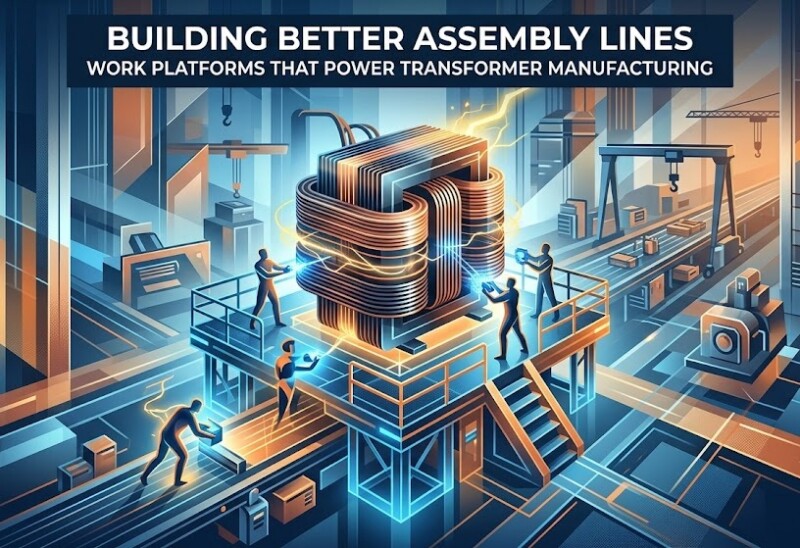
[Article]: Building Better Assembly Lines: Work Platforms That Power Transformer Manufacturing
Transformer manufacturing demands precision at every stage, with workers operating massive equipment at significant heights where safety and efficiency remain paramount.
Specialized work platforms deliver the stable access and ergonomic positioning needed for teams to complete complex, automated tasks without compromising worker well-being or production timelines.
The Critical Role of Safety in Transformer Assembly
The Occupational Safety and Health Administration (OSHA) mandates that aerial lifts acquired after July 1975 must comply with specific safety requirements outlined in American National Standards Institute (ANSI) guidelines. These regulations apply to vehicle-mounted devices designed to elevate workers, including extensible boom platforms, aerial ladders, articulating boom platforms and vertical towers.
Transformer standards are especially critical in transformer assembly, where operations face unique fall hazards due to the scale and complexity of the equipment. When workers operate at heights of 6 feet or more, OSHA requires employers to provide fall protection, making compliant platform systems essential. The right configuration helps operations meet regulatory requirements while maintaining efficient workflow around large transformer assemblies.
Improving Ergonomics and Productivity on the Line
Work-related musculoskeletal disorders represent a significant concern in heavy manufacturing where workers repeatedly reach, lift and handle components. These cumulative injuries develop from several contributing factors that place excessive pressure on muscles, tendons, bones and nerves.
For instance, high-intensity exertion creates problems through repetitive force application during assembly tasks, straining muscle groups over time. Awkward positioning while accessing elevated components also contributes to chronic strain and discomfort.
Research in the automotive industry quantifies this risk, showing that 63.7% experienced musculoskeletal injuries during employment, with lower back pain as the most prevalent issue at 29.6%. The data underscores why ergonomic equipment matters in similar heavy-assembly settings, such as transformer production.
Properly engineered work platforms reduce strain by eliminating overextension while providing a stable footing at optimal working heights. Personnel who can work comfortably with their tasks help operations improve both safety outcomes and production efficiency.
Top 5 Work Platform Providers for Transformer Manufacturing
Selecting the right provider requires evaluating capabilities tailored to transformer assembly challenges. These companies offer equipment designed to address the safety, ergonomic and productivity demands outlined above.
1. LPI Lift Systems
LPI Lift Systems (LPI) designs and fabricates personnel lifts and work platforms purpose-built for energy-sector applications. The company offers both an extensive standard product line and custom options tailored to individual needs. What distinguishes LPI is its focus on heavy-duty construction and configurations engineered to match operational specifications.
LPI platforms provide precise positioning, removing the need for ongoing manual adjustments during assembly. This stability enables workers to maintain focus on their tasks rather than on equipment manipulation, directly contributing to greater productivity. The company prioritizes safer access through thoughtful features that address fall protection and ergonomic concerns inherent in transformer manufacturing.
Key Features
- High-reach scissor lifts with 3-axis extension
- Cantilevered designs and boom arms
- Custom tool trays and storage compartments
- Integrated lighting and power options
2. ErectaStep
ErectaStep specializes in modular industrial access equipment for manufacturing and warehouse settings. The company uses a patented, laser-cut approach featuring sturdy aluminum construction with powder-coated handrails for durability and longevity. This modular design eliminates the need for custom fabrication or costly engineering services.
Installation requires no welding or specialized tools, enabling rapid deployment of standardized access solutions. Its platforms provide strength while remaining highly portable, and powder-coated finishes ensure long-term performance in demanding industrial environments.
Key Features
- Modular aluminum construction for easy reconfiguration
- Powder-coated handrails and nonslip surfaces
- OSHA-compliant builds for industrial settings
- Quick installation without welding or specialized tools
3. Metallic Ladder
Metallic Ladder manufactures lightweight work platforms using aerospace-grade aluminum for industrial applications. Available in both stationary and rolling configurations, all models feature durable construction for straightforward installation. This design also makes repositioning practical as layouts evolve, supporting flexible manufacturing requirements.
Rolling versions include 6-inch casters designed for optimal portability across manufacturing floors. The casters feature swivel locks that convert them into rigid wheels for controlled straight-line movement, supporting operations that need to reposition access equipment frequently during different assembly phases.
Key Features
- Aerospace-grade aluminum for strength and portability
- Rolling and stationary configurations
- 6-inch locking casters for secure positioning
- Lightweight builds for easy relocation
4. Aluworkplatform
Aluworkplatform conducts 3D modeling, stress calculations and finite element analysis before fabricating each platform to ensure structural integrity. This approach verifies load capacity and structural performance before manufacturing begins, reducing risk in critical applications.
Products comply with EN12312-8, EN ISO14122, MH/T3012.17-2010, GB17888 and other required international standards for industrial access equipment.
This multi-standard compliance makes Aluworkplatform particularly suited for international operations or facilities that must meet varied regulatory frameworks.
Key Features
- Aluminum alloy construction with corrosion resistance
- 3D modeling and finite element analysis for structural validation
- Compliance with multiple international safety standards
- Custom engineering for demanding load specifications
5. Autoquip
Autoquip brings extensive experience in control system development, programmable logic controller (PLC) programming and systems integration to deliver reliable automated options. Its automation expertise distinguishes the manufacturer from providers focused solely on manual equipment.
The technical capabilities support operations seeking integrated platform systems that coordinate with existing production equipment. Automated material handling further ensures consistent positioning and can reduce cycle times in high-volume manufacturing environments where manual adjustments would slow operations.
Key Features
- Custom-engineered builds for specialized applications
- PLC programming and automated control systems
- Systems integration with existing equipment
- Hydraulic and mechanical lift mechanisms
Comparing Platform Providers at a Glance
Each provider offers distinct capabilities suited to different operational needs. This comparison highlights key differentiators to help decision-makers evaluate which work platforms best match their transformer manufacturing demands.
|
Provider |
Specializes in Customization |
Offers Preconfigured Models |
Key Industries Served |
Notable Capabilities |
|
LPI Lift Systems |
Yes |
Yes |
Energy, manufacturing |
3-axis extension, custom tool integration |
|
ErectaStep |
No |
Yes |
General industrial |
Modular design, quick installation |
|
Metallic Ladder |
Limited |
Yes |
General industrial |
Portable rolling platforms |
|
Aluworkplatform |
Yes |
Yes |
International industrial |
Engineering analysis, multi-standard compliance |
|
Autoquip |
Yes |
Limited |
Manufacturing, warehousing |
PLC integration, automated controls |
Evaluation Criteria for Work Platforms
The companies featured in this overview were selected based on several factors relevant to transformer assembly:
- Industry specialization: Familiarity with energy or heavy manufacturing indicates an understanding of the scale and complexity of transformer equipment.
- Customization capabilities: Standardized platforms often cannot accommodate the dimensional specifications required for efficient assembly work.
- Safety compliance: Equipment must meet OSHA and ANSI standards for fall protection and load capacity.
- Ergonomic design: Features that reduce worker strain receive priority, given the documented prevalence of musculoskeletal injuries in manufacturing.
- Technical expertise: Providers with capabilities in systems integration or engineered analysis offer advantages for plants with complex production demands.
Choosing the Right Platform for Your Facility
Investing in appropriate work platforms protects both worker safety and operational efficiency in transformer manufacturing.
Operations should assess their access challenges and regulatory compliance needs when evaluating providers, then consult with experienced platform manufacturers to ensure selected equipment addresses the dimensional and functional demands unique to each plant.













Interested? Submit your enquiry using the form below:
Only available for registered users. Sign In to your account or register here.