




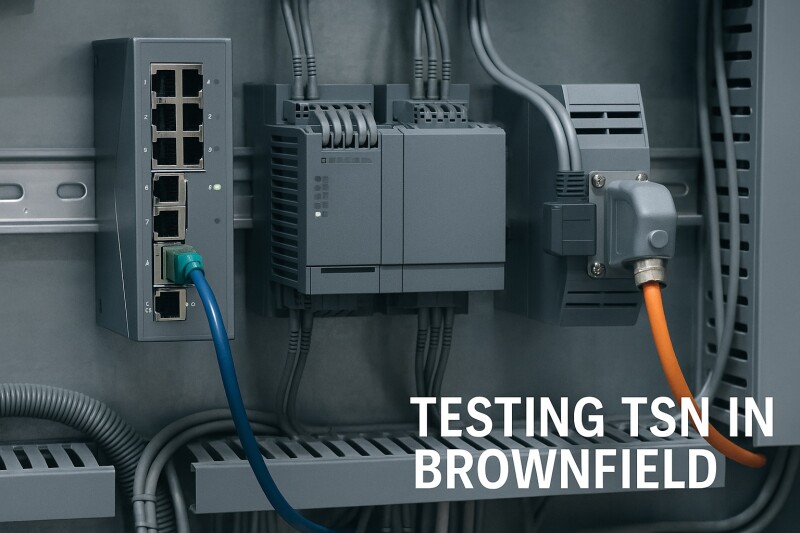
Testing TSN in Brownfield: How to Pilot Without a Full Rip-and-Replace
Time-Sensitive Networking (TSN) promises deterministic Ethernet for industrial control — but deploying it in existing plants can feel risky. Most production environments can’t afford extended downtime or rewiring. Fortunately, a TSN pilot can be run in a brownfield environment with minimal disruption, proving value before full rollout.
Why Pilot First
TSN is more than a faster Ethernet — it’s a set of IEEE standards (802.1AS, 802.1Qbv, 802.1Qbu) that add precise synchronization and traffic shaping. Testing ensures compatibility with existing switches, PLCs, and motion systems before large-scale adoption.
Designing a Minimal TSN Pilot
A successful pilot validates timing, interoperability, and diagnostics. Key design steps:
- Choose a representative cell: Select one production area with diverse device types (sensors, PLCs, drives).
- Use TSN-capable switches: Confirm IEEE 802.1AS and 802.1Qbv support.
- Integrate gateways: Connect non-TSN devices via legacy bridges to maintain process continuity.
- Capture performance baselines: Measure jitter, cycle time, and packet loss before and after TSN.
Test Metrics to Capture
| Metric | Target Value | Purpose |
|---|---|---|
| Synchronization accuracy | ±100 ns | Validate time alignment |
| End-to-end latency | <1 ms | Ensure control response |
| Jitter | <50 µs | Verify determinism |
| Packet loss | 0% | Guarantee reliability |
Best Practices
- Use managed switches with TSN-aware monitoring tools.
- Run the pilot in parallel to live control to compare real-world latency.
- Log data using OPC UA PubSub diagnostics for auditability.
- Keep pilot duration 4–6 weeks to capture full production variability.
Case Example: Food Packaging Line
A food packaging OEM installed a TSN test ring beside its existing PROFINET network. Synchronization achieved 90 ns deviation across 8 nodes, proving TSN compatibility with existing controllers. The success justified a phased migration plan for 40 lines.
Scaling from Pilot to Production
After pilot validation, integrate TSN islands gradually — replacing one cell at a time and reusing certified switches. Ensure firmware uniformity across vendors, as non-synchronized clocks can degrade performance even if compliant on paper.
Related Articles
- From Fieldbus to Ethernet: Migration Paths That Don’t Break Production
- OPC UA over TSN Explained: Determinism Without Vendor Lock-In
- Vendor Interoperability Check: What to Ask Before You Buy
Conclusion
Testing TSN in brownfield plants doesn’t require a full overhaul. A targeted pilot validates timing, security, and interoperability while maintaining uptime. This approach builds confidence for full-scale convergence between IT and OT networks.















Interested? Submit your enquiry using the form below:
Only available for registered users. Sign In to your account or register here.