





[Article]: Accelerating BEAD Deployments with High-Performance HDPE Conduit Solutions
With the Broadband Equity Access and Deployment Program (BEAD) program’s awards finally evolving into action, the pressure is on to deploy underground telecom infrastructure faster and more efficiently. Success hinges on material selection, which determines everything from fatigue resistance to ultraviolet (UV) light sensitivity.
While polyvinyl chloride (PVC) and rigid metal conduits are popular choices for fiber-optic conduit protection, high-density polyethylene (HDPE) conduits offer superior telecom durability. With this material, entities can accelerate BEAD deployments. We drew on insights from industry authority Viaflex to develop this guide.
How BEAD Impacts Infrastructure Demands
BEAD is a $42.45 billion federal initiative that intends to connect every American to high-speed internet by funding widespread telecom infrastructure projects. States are beginning to see these funds in action. As of December 2025, the National Telecommunications and Information Administration approved 29 final proposals.
For the wire and cable industry, a project this ambitious presents certain execution challenges. The funding may be available, but professionals are not entirely shovel-ready. They face aggressive timelines, diverse terrain and space-constrained jobsites.
However, industry professionals can’t afford for an initiative of this magnitude to fail. They must balance ease of installation and long-term network reliability to protect this historic investment in America’s underground telecom infrastructure.
Why HDPE Is the Preferred Choice for BEAD
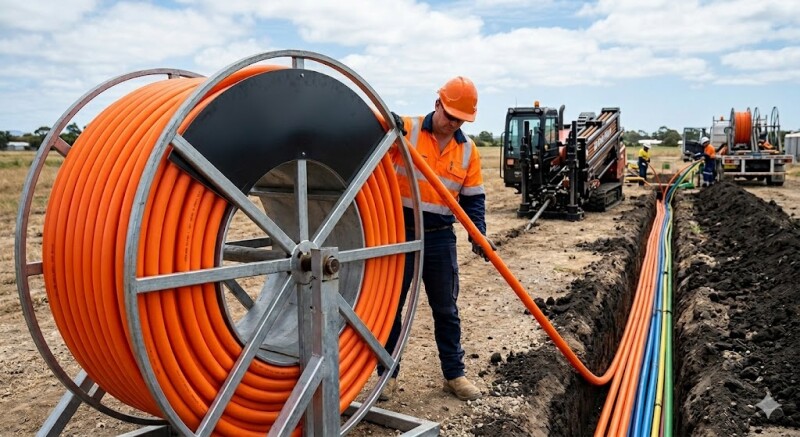
HDPE is a thermoplastic resin that withstands harsh environments and flexes without breaking. It is supplied in long coils or reels for compact transport and easy installation with fewer joints. Both PVC and rigid metal share some of these qualities, but HDPE offers additional benefits. This material is uniquely suited for large-scale, publicly funded projects like BEAD:
- High durability: Being impervious to bacteria and protected against corrosion ensures the longevity of the sensitive fiber-optic cables within.
- Low friction coefficient: HDPE facilitates longer cable pulls with less tension, which is ideal for trenchless installation. The capability helps reduce surface disruption and restoration costs.
- Ease of handling: The lightweight, flexible reels are easy to transport, handle and install, which can decrease shipping and labor expenses.
- Superior flexibility: The conduit’s high flexibility and pull strength help it resist breakage, even when the ground shifts, heaves or settles.
Aside from cracking and crushing pressure, corrosion is one of the main threats underground telecom infrastructure faces. Natural corrosion resistance is essential for installations intended to have a long service life. Projects funded by BEAD must last for generations, so it is in entities’ best interest to future-proof these networks.
Unlike other commonly used materials, HDPE is inherently resistant to the elements that cause buried materials to degrade. Conduits manufactured with 100% premium-grade resin offer superior structural integrity, durability and resistance to environmental factors. High-quality resin minimizes corrosion and weather-related degradation.
While HDPE installations are not yet common, they have shown exceptional performance in real-world scenarios. Studies show that it experiences approximately one failure per 10 million stress events, while PVC fails once in every 48,650 stress events.
What to Look for in an HDPE Conduit Supplier
The ideal HDPE conduit supplier is strategically located in the heart of the United States to ensure timely deliveries to any major city. Fast lead times can help states meet tight project timelines and minimize construction-related disruption.
Additionally, materials should meet all Build America, Buy America (BABA) standards to comply with BEAD deployment requirements. Domestically produced HDPE conduit strengthens telecom durability by mitigating the risks of counterfeiting and low-quality production.
Customizability may not be as important as compliance and technical specifications, but it is still a primary deciding factor. Aside from offering aesthetic benefits, conduits that come in various sizes and colors simplify installation. Providers should work closely with clients to design and manufacture conduit pipe tailored to their project-specific needs.
With expertise in polymer manufacturing since 1973, Viaflex is an authority on pipe and conduit products. Its products are built to meet the highest industry standards and withstand the harshest environments, making them ideal for fiber-optic conduit protection. The company specializes in large-scale deployment, with over 80 million feet of conduit available for production annually.
For instance, the PE4710 high-performance resin pipe has a 50-year service life, minimizing replacement costs. It meets or exceeds ASTM standards D2239, D2737, D3035 and D3350, as well as AWWA C901 and NSF/ANSI 14. Its conduits are also manufactured with 100% premium-grade resin.
Frequently Asked Questions About HDPE
Entities considering procuring HDPE should refer to these frequently asked questions to better understand its performance and material properties.
What is the life expectancy of HDPE pipe?
HDPE pipes outlast PVC and even rigid metal due to their superior flex and corrosion resistance. Studies show they can last up to 100 years in real-world conditions. Its lengthy service life makes it a viable alternative to traditional steel pipes. Despite being a thermoplastic, its high chemical, fatigue and corrosion resistance contribute to its exceptional durability.
Is standard HDPE resistant to sunlight?
Although UV exposure is not a concern for underground telecom infrastructure, it is good to know that standard HDPE offers moderate UV resistance. A UV-stabilized grade is recommended for outdoor applications.
Is HDPE a sustainable solution for telecom?
HDPE is a relatively sustainable solution for telecom infrastructure, as it is safe to manufacture, deploy and incinerate. Since it resists breakage, it reduces the need for costly, resource-intensive repairs, mitigating unnecessary raw material procurement. As a highly recyclable thermoplastic, it can be repurposed at the end of its service life.
What are the long-term benefits of HDPE?
The immediate benefits of HDPE include lower capital investments. Since it offers superior fiber-optic conduit protection, maintenance costs are also lower. Both translate to long-term cost savings. While leftover BEAD funds will likely be used for deployment or returned to the Treasury, states can learn from this experience to slash the costs of future telecom initiatives.
Do materials need to comply with BABA?
Projects must be BABA-compliant. The subgrantee and contractors must certify that materials and equipment have undergone all manufacturing processes domestically to comply with the domestic procurement preference.
The goal of prioritizing domestic procurement is to ensure domestic infrastructure products and components contribute to the national economy. Sourcing materials domestically supports American jobs and local industries, fostering economic growth. It also ensures federally funded telecom and construction projects comply with applicable regulations.
Accelerating BEAD Deployments With HDPE
When ease of installation and telecom durability take priority, HDPE conduit is the only viable choice. It is the preferred choice for long-distance underground telecom infrastructure due to its superior flexibility, durability and reliability.














Interested? Submit your enquiry using the form below:
Only available for registered users. Sign In to your account or register here.