



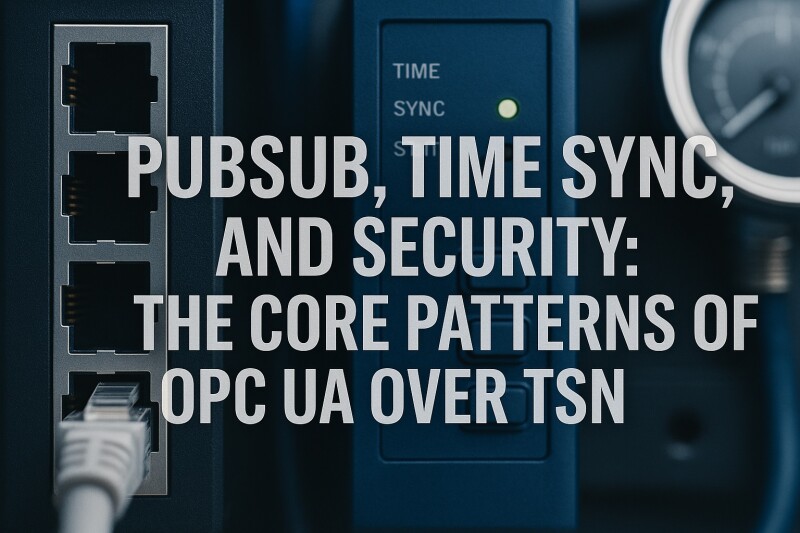
PubSub, Time Sync, and Security: The Core Patterns of OPC UA over TSN
OPC UA over TSN (Time-Sensitive Networking) is the backbone of industrial Ethernet convergence. Its strength lies in three architectural pillars: Publish/Subscribe messaging, time synchronization, and end-to-end security. Understanding these patterns is key to designing deterministic, interoperable systems that scale beyond proprietary automation islands.
Publish/Subscribe: Data Without Polling
Traditional OPC UA client/server models rely on polling, adding latency. The PubSub model changes this—data is published by devices and subscribed to by any authorized consumer. Messages travel over UDP multicast or TSN streams, enabling sub-millisecond delivery without central brokers.
Time Synchronization: The Clock that Rules All
TSN’s IEEE 802.1AS ensures all network devices share a common clock. Every packet can be timestamped, guaranteeing deterministic latency and enabling synchronized motion control across vendors.
Security Without Sacrificing Speed
OPC UA’s security model combines encryption (TLS or Datagram TLS) with certificate-based authentication. TSN adds hardware-level isolation, ensuring that even mixed traffic (e.g., video + control) maintains guaranteed slots and priorities.
Engineering Best Practices
- Use Network Time Protocol (NTP) only for IT; rely on 802.1AS for OT timing.
- Segment networks by priority class (critical control, diagnostics, non-critical).
- Audit all certificate chains—expired certs are a top cause of downtime.
- Simulate jitter under network stress to verify time-aware shaping (802.1Qbv).
Case Example: Robotics Workcell
A robotics integrator implemented OPC UA PubSub over TSN to coordinate six-axis arms and conveyors. Latency dropped to 250 µs with jitter under 50 µs—unachievable with traditional Ethernet/IP polling. All devices from three vendors synchronized within ±100 ns.
Benefits Summary
- Deterministic Ethernet without proprietary stacks
- Lower CPU load vs. client/server architectures
- Simpler multi-vendor interoperability
- Future-proof foundation for edge and cloud integration
Related Articles
- From Fieldbus to Ethernet: Migration Paths That Don’t Break Production
- OPC UA over TSN Explained: Determinism Without Vendor Lock-In
- Vendor Interoperability Check: What to Ask Before You Buy
Conclusion
OPC UA over TSN’s core patterns—PubSub, time sync, and security—represent the foundation of open, deterministic Ethernet. Together, they enable precise coordination, vendor neutrality, and end-to-end security for the next decade of industrial automation.














Interested? Submit your enquiry using the form below:
Only available for registered users. Sign In to your account or register here.