


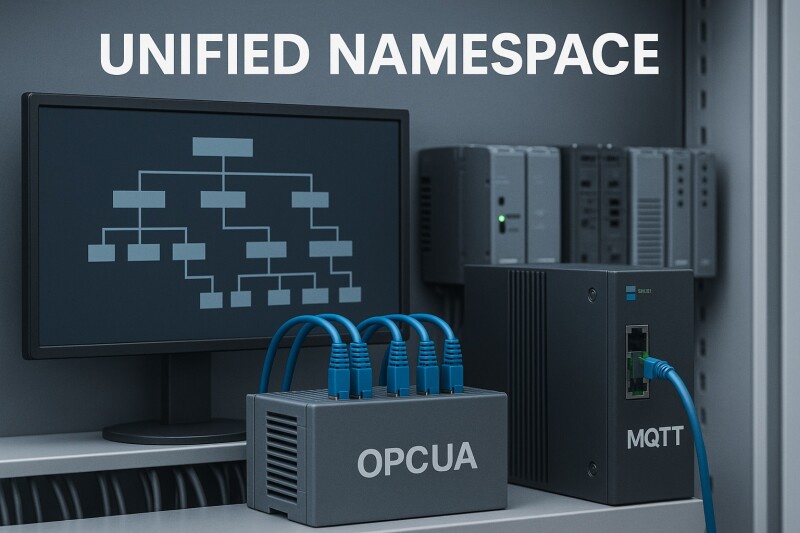
Unified Namespace in Practice: Topic Taxonomy That Scales
The Unified Namespace (UNS) has become the backbone of Industry 4.0 architectures. It provides a single, organized, and vendor-neutral view of all production data — published and subscribed via protocols like MQTT or AMQP. But implementing a scalable topic structure that works across teams, vendors, and business systems is often harder than it looks.
What Is a Unified Namespace?
A Unified Namespace is not a product or software — it’s a data architecture concept. It defines how operational data (OT) and business data (IT) coexist under a single, consistent topic hierarchy. Each piece of equipment, line, and system publishes its own data contextually, enabling interoperability across layers.
Designing a Scalable Topic Taxonomy
Think of UNS topics as folders in a file system. The key is consistent naming:
factory/line1/robot1/status factory/line1/robot1/temperature factory/line1/robot2/status factory/packaging/oee
Best Practices
- Use semantic naming — include plant, line, asset, and variable hierarchy.
- Separate command and state topics clearly (e.g., /cmd vs /status).
- Define ownership boundaries — who publishes, who subscribes.
- Leverage Sparkplug B for auto-discovery and state management.
Governance and Change Control
Once deployed, topic hierarchies are hard to change. Use a governance committee to approve new topics or renames. Document conventions in a living standard accessible to all integrators and suppliers.
Case Example: Food & Beverage Manufacturer
A global beverage producer implemented a UNS across 12 plants using MQTT. Topic standardization reduced integration time by 40% and eliminated redundant SCADA connections. The same taxonomy now feeds OEE dashboards, AI quality systems, and MES analytics.
Related Articles
- Sparkplug B vs Plain MQTT: What Manufacturers Actually Need
- Building an Enterprise UNS: Naming, Ownership, and Data Governance
- MQTT + Kafka + OPC UA: A Modern OT/IT Data Backbone
Conclusion
A Unified Namespace only delivers value when it’s structured, governed, and consistently applied. The right taxonomy transforms raw data into usable context — connecting every system, from PLC to ERP, under one scalable digital language.











Interested? Submit your enquiry using the form below:
Only available for registered users. Sign In to your account or register here.