




Servo Tuning in 2025: Autotune vs Manual — Who Wins?
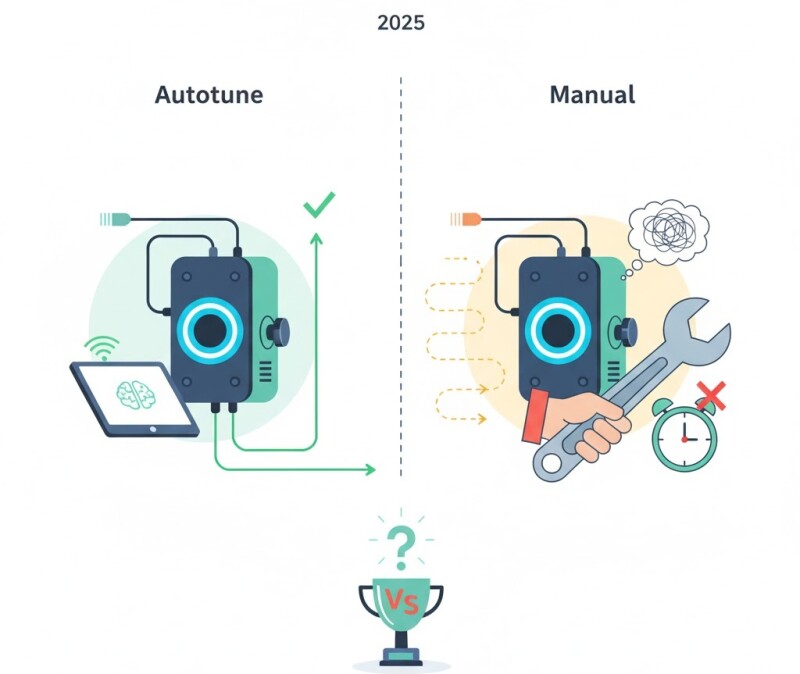
Servo tuning has evolved from oscilloscopes and intuition to software-assisted autotuning. In 2025, AI-based tuning algorithms promise performance gains with less engineering time — but manual expertise still matters.
How Autotuning Works
- Drives perform controlled excitation tests to identify motor and load inertia.
- Algorithms calculate proportional, integral, and derivative gains automatically.
- Advanced drives now include AI-assisted self-learning that adjusts gains dynamically under load.
Benefits
- Setup time reduced by 70–90% on new machines.
- Consistent results across technicians.
- Adaptive tuning compensates for temperature and wear.
When Manual Tuning Wins
- Highly flexible machines with variable inertia (e.g., robotics, packaging).
- Precision-critical applications (e.g., electronic assembly, laser cutting).
- Noise or compliance requires fine damping adjustments.
Hybrid Approach
Best practice is to start with autotune and refine manually. Tools like Bode plot visualization and FFT analysis still reveal resonance modes autotune may miss.
Example
An OEM achieved ±0.02° accuracy on rotary tables using adaptive autotuning plus manual damping tweaks. Setup time dropped from 4 hours to 45 minutes.
Related Articles
- Selecting Encoders: Incremental, Absolute, and Safety
- Multiaxis Coordination: Gearing, Cam Tables, and Jerk
- Regeneration and Braking: Energy and Safety Considerations
Conclusion
Autotune is faster, but expertise still wins the edge. In 2025, hybrid tuning — machine learning plus engineering judgment — delivers the best of both worlds.













Interested? Submit your enquiry using the form below:
Only available for registered users. Sign In to your account or register here.