


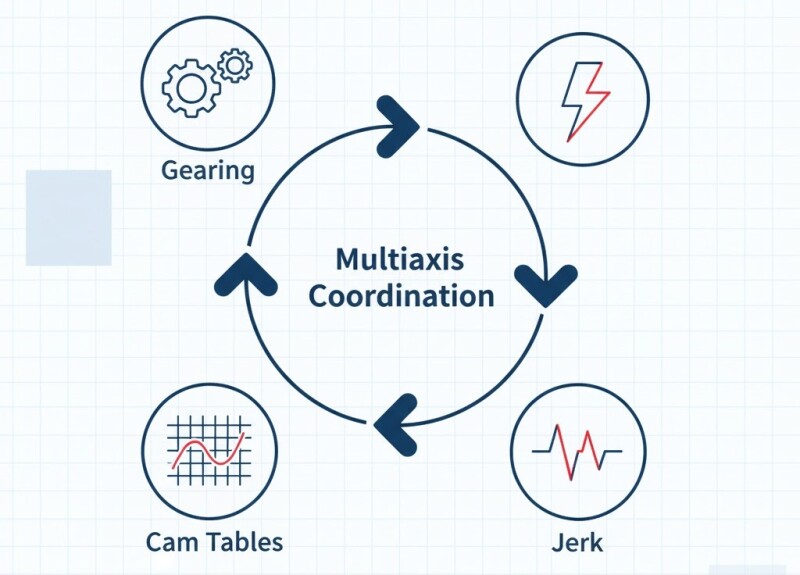
Multiaxis Coordination: Gearing, Cam Tables, and Jerk
Complex motion systems — from packaging machines to printing presses — rely on precise coordination of multiple servo axes. Synchronization methods like electronic gearing and cam tables replace mechanical linkages with software precision.
Electronic Gearing
- One “master” axis defines position; followers track via a ratio (e.g., 2:1).
- Enables smooth speed changes without physical couplings.
- Requires tight communication latency (≤1 ms) for accuracy.
Cam Tables
- Store position profiles as lookup curves between master and slave.
- Ideal for complex motion such as sealing jaws or press feeders.
- Changeover achieved instantly by loading new tables — no mechanical cams.
Managing Jerk (Rate of Acceleration Change)
Controlling jerk improves product quality and mechanical life. Use S-curve profiles to smooth transitions. Modern motion controllers support jerk-limited profiles natively, reducing vibration and mechanical wear.
Example
A bottling line implemented multi-axis gearing for 10 synchronized servos. With optimized jerk profiles, vibration decreased by 40%, extending machine uptime between maintenance cycles.
Related Articles
- Servo Tuning in 2025: Autotune vs Manual — Who Wins?
- Selecting Encoders: Incremental, Absolute, and Safety
- EtherCAT, PROFINET, and TSN: Choosing Your Motion Bus
Conclusion
Software-based coordination eliminates mechanical complexity. Proper jerk control and synchronization tuning ensure high-speed precision without excessive wear.










Interested? Submit your enquiry using the form below:
Only available for registered users. Sign In to your account or register here.