





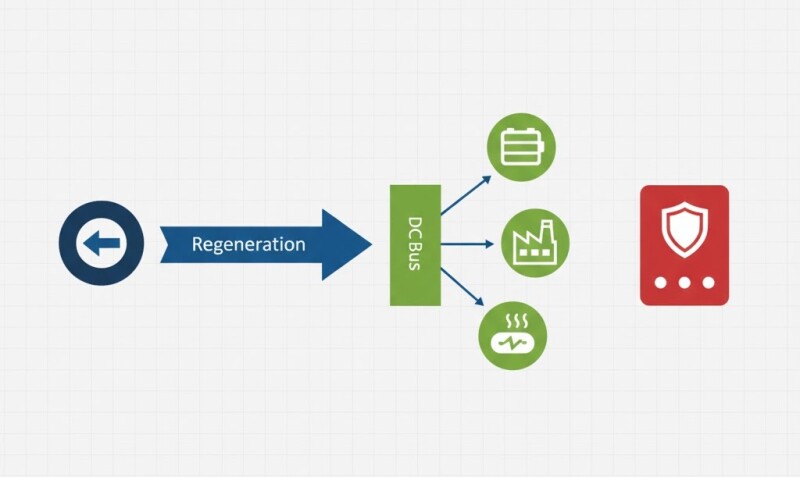
Regeneration and Braking: Energy and Safety Considerations
Modern motion systems don’t just move — they recover energy. Regenerative braking can reduce energy consumption by up to 30%, but it introduces new safety and design considerations for industrial drives.
How Regeneration Works
During deceleration, a motor becomes a generator, feeding current back to the DC bus. That energy must either be reused, stored, or safely dissipated.
Three Common Strategies
- Dynamic Braking Resistors: Convert energy to heat; simple and reliable for single-axis systems.
- Regenerative Units: Feed energy back to the plant grid; best for multi-axis or high-duty systems.
- DC Bus Sharing: Connect drives to share regenerative energy between axes.
Safety Considerations
- Ensure resistor sizing matches worst-case kinetic energy.
- Use thermal monitoring to detect resistor overloads.
- In systems with safety stop functions (STO/SS1), braking circuits must default to a safe state.
Energy Efficiency Opportunities
- Use energy storage modules (supercaps) to smooth peaks.
- Recover braking energy into plant AC systems via regenerative power supplies.
- Monitor drive DC bus voltage and current for predictive maintenance.
Example
A conveyor line with 20 servo axes added a shared DC bus and regenerative supply. The plant reduced peak demand by 18% and cut resistor failures to zero.
Related Articles
- Servo Tuning in 2025: Autotune vs Manual — Who Wins?
- Selecting Encoders: Incremental, Absolute, and Safety
- EtherCAT, PROFINET, and TSN: Choosing Your Motion Bus
Conclusion
Energy recovery is both an efficiency and safety challenge. Correct sizing, monitoring, and control integration turn regeneration into a competitive advantage — not a risk.















Interested? Submit your enquiry using the form below:
Only available for registered users. Sign In to your account or register here.