





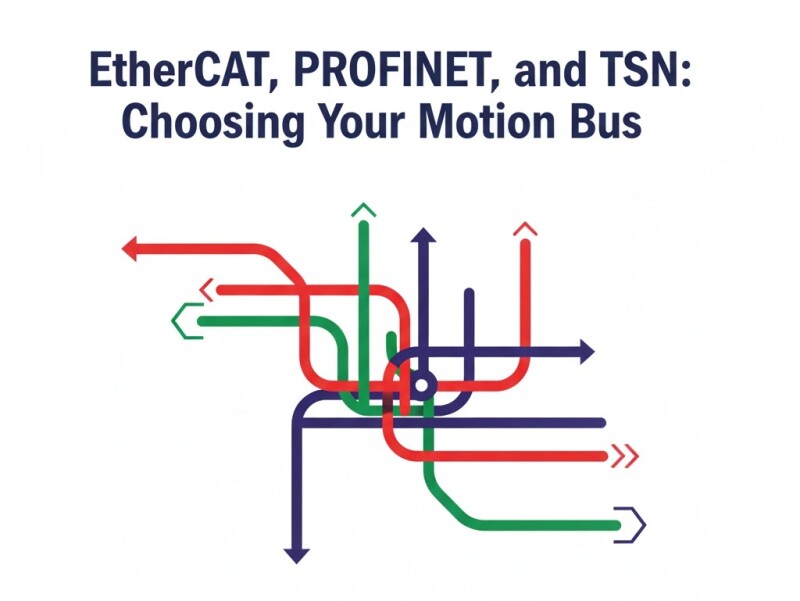
EtherCAT, PROFINET, and TSN: Choosing Your Motion Bus
Choosing a real-time Ethernet network for motion control can make or break system performance. EtherCAT, PROFINET IRT, and TSN-based architectures all promise deterministic control — but they differ in openness, scalability, and integration effort.
EtherCAT: Speed and Precision
- Cycle times down to 62.5 μs.
- Hardware-level synchronization via Distributed Clocks (DC).
- Ideal for servo synchronization and robotics.
- Downside: master stack licensing and vendor variation.
PROFINET IRT: Integrated with Siemens Ecosystem
- Cycle times ~250 μs typical.
- Tight integration with TIA Portal, safety, and diagnostics.
- Best choice for users standardizing on Siemens automation.
- Less flexible outside Siemens environments.
TSN: The Future-Ready Option
- IEEE 802.1 Time-Sensitive Networking adds deterministic traffic to standard Ethernet.
- Vendor-neutral, supports OPC UA PubSub and mixed workloads.
- Still emerging for full motion control synchronization — 2026+ maturity expected.
Selection Guidelines
- High-speed robotics → EtherCAT.
- Standardized Siemens plants → PROFINET IRT.
- Future-proof mixed vendors → TSN + OPC UA PubSub.
Example
An OEM migrating from PROFINET to EtherCAT cut cycle time by 60% and achieved tighter synchronization between servo axes, enabling new high-speed packaging designs.
Related Articles
- Regeneration and Braking: Energy and Safety Considerations
- Servo Tuning in 2025: Autotune vs Manual — Who Wins?
- Selecting Encoders: Incremental, Absolute, and Safety
Conclusion
There’s no single winner in motion networking — only the best fit. EtherCAT rules in precision, PROFINET in integration, and TSN in long-term openness. The future likely combines all three.















Interested? Submit your enquiry using the form below:
Only available for registered users. Sign In to your account or register here.