





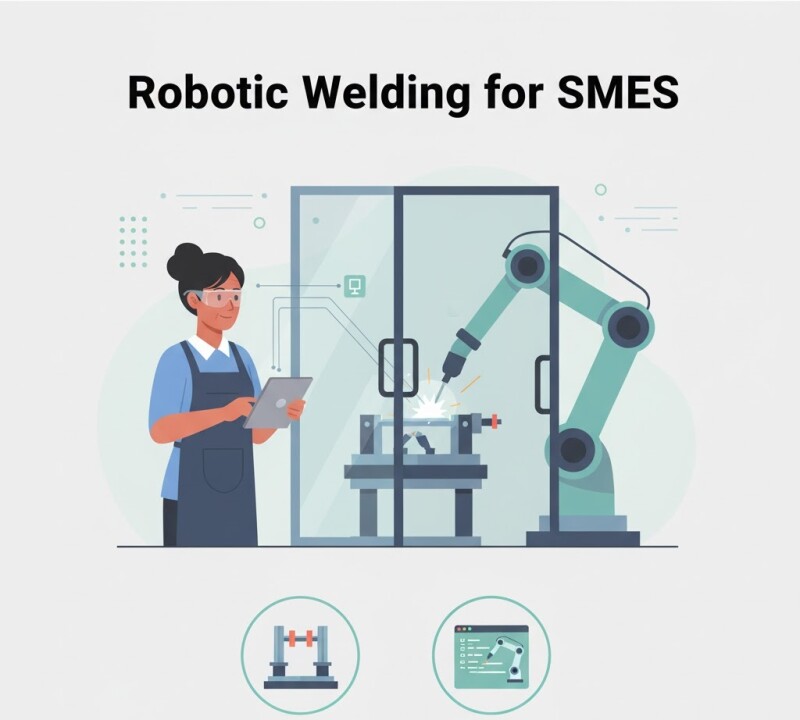
Robotic Welding for SMEs: Fixturing and Programming
Small and medium manufacturers often see robotic welding as out of reach. Yet modern cobot welders and simplified software are changing that. Success depends on fixturing and programming more than hardware cost.
1. The Fixture Is the Process
Good welding starts with repeatable positioning. Use modular jigs or magnetic fixtures to achieve consistent part alignment within ±0.25 mm. This reduces touch-ups and program adjustments.
2. Simplified Programming for SMEs
Low-cost systems now offer drag-and-teach interfaces and visual path recording. For short runs, point-to-point teaching beats offline programming in setup time.
3. Integration Tips
- Plan cable management early — heat and spatter can damage signal lines.
- Use welding tables with integrated ground planes.
- Implement safety-rated fume extraction where humans share space.
Example
A 20-person fabrication shop automated a MIG process using a collaborative arm and modular fixtures. ROI: 9 months, with weld rework cut by 60%.
Related Articles
- Seam Tracking with Vision and Through-Arc
- Heat, Spatter, and Safety: What to Engineer Upfront
- Offline Programming: From CAD to Weld Path
Conclusion
For SMEs, robotic welding is a process-engineering problem, not a capital problem. Start with fixturing and smart programming — the robot will follow.











Interested? Submit your enquiry using the form below:
Only available for registered users. Sign In to your account or register here.