





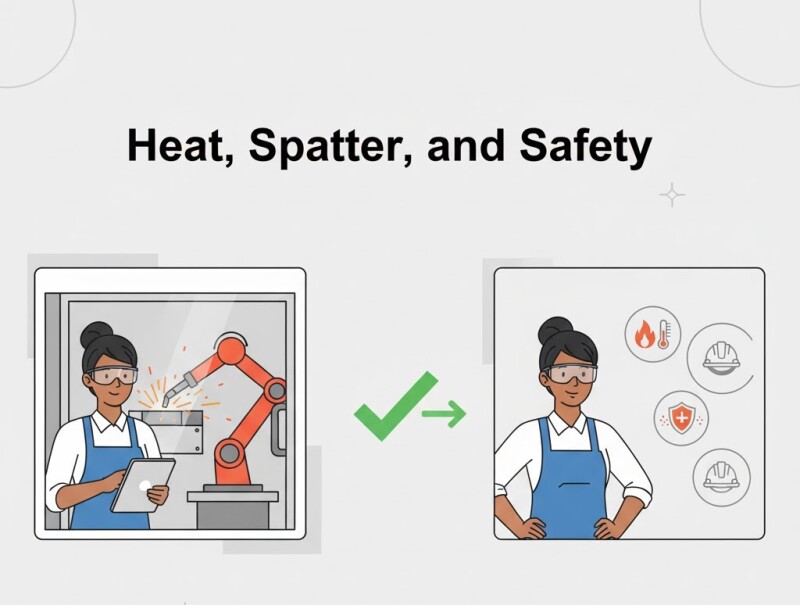
Heat, Spatter, and Safety: What to Engineer Upfront
Welding automation is as much about safety and environment as about precision. Poor planning around heat, spatter, and ventilation can shorten equipment life and expose workers to risk.
1. Thermal Design
Design fixtures and guards from heat-resistant materials. Use active cooling for torch mounts and avoid proximity to temperature-sensitive sensors.
2. Spatter Management
- Apply anti-spatter coatings to nozzles and clamps.
- Use air knives to clear the weld area between passes.
- Install protective glass over vision sensors.
3. Safety and Fume Control
Collaborative welding requires safety zones, optical barriers, and high-efficiency fume extraction (EN ISO 15012-1). Never rely on general ventilation alone.
Example
A job shop reduced torch downtime by 40% after implementing spatter-resistant fixtures and heat shields designed for 400 °C environments.
Related Articles
- Robotic Welding for SMEs: Fixturing and Programming
- Seam Tracking with Vision and Through-Arc
- QA for Welding Cells: Coupons, Coupons, Coupons
Conclusion
Engineering for welding safety starts before power-on. Robust materials, controlled heat zones, and airflow design guarantee both uptime and compliance.















Interested? Submit your enquiry using the form below:
Only available for registered users. Sign In to your account or register here.