




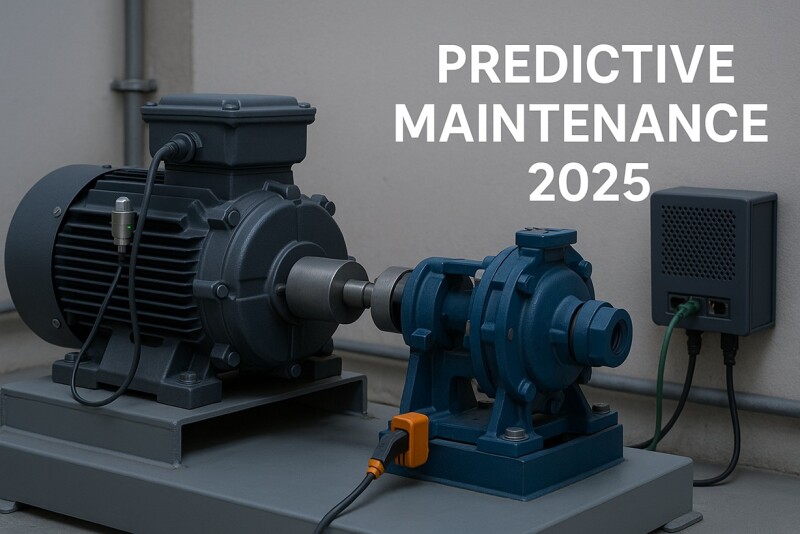
Predictive Maintenance in 2025: Sensors, Signals, and Real ROI
Predictive maintenance (PdM) has matured from pilot dashboards to measurable business outcomes. In 2025, the winning programs look different: they blend fit-for-purpose sensors, edge analytics for timely decisions, and governed data pipelines that feed continuous model improvement. This article summarizes what actually works on the plant floor—covering sensor choices, signal processing, model patterns, and a practical ROI model you can defend to finance.
The 2025 PdM Stack at a Glance
- Sensor tier: Triaxial vibration, airborne acoustic, motor current signature, thermal, process (pressure/flow), and oil condition—selected per failure mode.
- Edge tier: Deterministic sampling, feature extraction, first-line anomaly scoring, and local buffering to ride out network gaps.
- Data tier: Time-series store (historian or cloud TSDB), feature registry, and governed access for analytics.
- ModelOps: Versioned models, drift detection, and safe rollouts from a central registry to the edge.
- Action tier: Work order integration (CMMS), clear thresholds, and SLA-backed escalation paths.
Choose Sensors by Failure Mode, Not by Catalog
Start from the physics of failure and map backwards to sensing:
- Bearings & imbalance/misalignment: Triaxial accelerometers (2–10 kHz), envelope analysis for early-stage faults, kurtosis and crest factor for impulsive events.
- Gearboxes: Vibration with order tracking; sidebands reveal wear and looseness. Add oil debris for confirmation.
- Pumps & fans: Vibration + process signals (flow/pressure) to separate hydraulic from mechanical issues.
- Motors & VFDs: Motor current signature analysis (MCSA) captures rotor/stator anomalies without mounting sensors on hot housings.
- Thermal problems & lubrication: Temperature and infrared spot checks; oil condition (viscosity, moisture, ferrous particles) for slow-evolving faults.
Rule of thumb: If the failure progresses in days to weeks and has a clear mechanical signature, you can justify a permanently installed sensor. For slow-degrading assets, route-based data collection may be enough.
Sampling and Edge Acquisition That Don’t Miss the Fault
The most common PdM mistake is undersampling. Align sampling with physics:
- Nyquist budget: Capture at least 5–10× the highest fault frequency of interest (e.g., 2–5 kHz for many bearings; higher for precision spindles).
- Synchronous windows: Use tach/encoder for order tracking on variable-speed equipment; resample to constant angle.
- Triggering: For reciprocating machines, event-triggered snapshots reduce storage while catching transients.
- Determinism: Run feature extraction on the edge to avoid WAN jitter; buffer raw segments locally for post-mortem.
Where hard real-time control coexists with analytics, OPC UA over TSN provides deterministic transport for setpoints and timestamps while analytics results can flow via standard IP.
Signal Processing: Features That Generalize Across Sites
Before any machine learning, robust features make PdM portable:
- Time-domain: RMS, peak-to-peak, crest factor, kurtosis, skewness—great for baselining and alarms.
- Spectrum: FFT magnitudes at defect-related orders; sideband energy around mesh frequencies for gears.
- Envelope & cepstrum: Picks up early-stage bearing defects masked by broadband noise.
- Time–frequency: STFT or wavelets for non-stationary signals; helpful on variable-speed lines.
- Process context: Append load, speed, and ambient conditions so models don’t learn false patterns.
Model Patterns That Work in Production
In 2025, plants blend physics and data-driven approaches rather than chasing a single algorithm:
- Self-supervised baselining: Autoencoders or one-class methods learn the healthy state per asset and flag reconstruction error spikes.
- Classical ML: Gradient-boosted trees on engineered features remain a strong, explainable baseline.
- Sequence models: Temporal CNNs or transformers on feature sequences capture slowly drifting behavior and seasonality.
- Hybrid rules + ML: Physics rules (e.g., temperature compensation, speed normalization) gate the ML alerts and cut nuisance alarms.
At the edge: run lightweight scoring (e.g., feature thresholds or compact autoencoders). In the cloud/on-prem: perform retraining, what-if analysis, and fleet benchmarking—see Edge vs Cloud for deployment trade-offs.
Alarm Strategy: From Scores to Work Orders
Maintenance teams need clear actions, not model scores. Implement:
- Tiers: Advisory (monitor), Warning (plan work), Critical (stop/derate). Each tier maps to CMMS actions and SLAs.
- Hysteresis: Enter and exit criteria prevent flapping around thresholds.
- Explainability: Attach top-contributing features/orders and similar historical cases to each alert.
- Verification: Every alert must be accepted/rejected by maintainers with root-cause notes—this is gold for retraining.
Connectivity & Data Governance
Successful programs standardize data shapes and access. Use a feature registry so “RMS_X” or “Kurtosis_Z” means the same across plants. For transport and interoperability, OPC UA information models simplify handoffs between OT vendors, while secure edge gateways buffer during outages and enforce least privilege access.
ROI That Finance Will Sign
Anchor your business case on avoided failures, reduced unplanned downtime, and optimized maintenance windows. A simple model:
Annual ROI = (Σ Avoided Downtime Hours × Contribution Margin/hour) + (Σ Avoided Repair Costs) + (Inventory Optimization Savings) - (Sensors + Edge HW Depreciation) - (Software/Cloud/Support Opex)
Example: A critical compressor (CM €12,000/h) historically causes 10 h of unplanned downtime/year and €30k in emergency repairs. After PdM, you cut unplanned downtime by 70% and move to planned maintenance. Savings: (7 h × €12,000) + (€21,000) = €105,000 per year for that asset alone—often exceeding the sensor and platform spend for the entire line.
Deployment Blueprint (90 Days)
- Week 1–2 — Asset selection & baselining: Pick top 10% critical assets by risk; record healthy signatures at multiple loads/speeds.
- Week 3–6 — Install & integrate: Mount sensors, commission edge gateways, normalize timestamps, and stream to your historian/TSDB.
- Week 7–8 — Features & first models: Stand up feature pipelines and baseline thresholds; start one-class models where data is sufficient.
- Week 9–10 — Alarms & workflows: Map tiers to CMMS; add explainability artifacts per alert.
- Week 11–13 — KPI validation & handover: Track precision/recall of alerts, mean time between failures (MTBF), and schedule adherence; finalize runbooks.
What Not to Do
- Don’t start with black-box models and sparse sensors—coverage beats cleverness.
- Don’t skip speed/load normalization; it’s the top cause of false alarms.
- Don’t hoard raw data indefinitely; keep raw snippets for forensics, but persist curated features and labels.
- Don’t ignore operators; their qualitative notes explain many anomalies your sensors can’t.
Lightweight Q&A
Can handheld/route-based measurements support PdM?
Yes—for slow-progress faults. Use them to seed baselines and justify permanent sensors on critical assets.
What precision should I target?
For critical assets, aim for >90% alert precision with <10% missed-failure rate, measured against verified work orders—not simulated data.
Edge or cloud for scoring?
Score at the edge for timely alarms and resilience; use cloud or on-prem clusters for retraining, fleet analytics, and governance.
Related Articles
- Edge AI vs Cloud AI for Manufacturing: Where Each Wins in 2025
- OPC UA over TSN Explained: Determinism Without Vendor Lock-In
- Vision AI on the Line: Beating Traditional Rules-Based Inspection
Conclusion
PdM in 2025 is no longer about experimental dashboards—it’s disciplined engineering. Select sensors by failure mode, enforce deterministic edge acquisition, standardize features, and operate governed models tied to CMMS workflows. When you quantify savings against avoided downtime and repairs, the ROI becomes clear and repeatable across sites.











Interested? Submit your enquiry using the form below:
Only available for registered users. Sign In to your account or register here.