





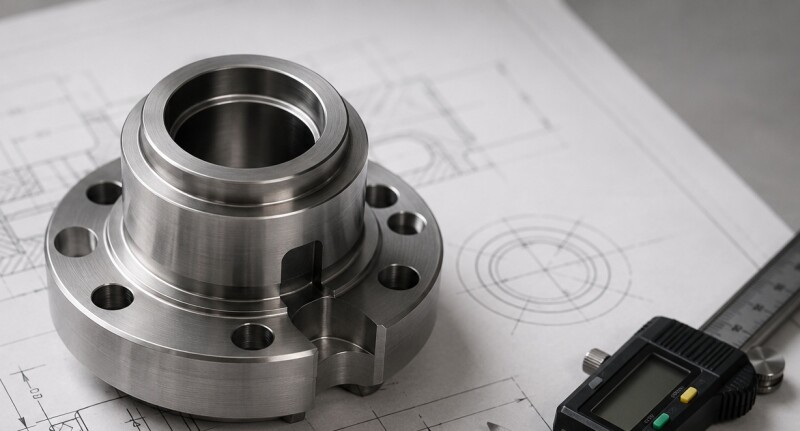
[Article]: How to Design Close-Tolerance Parts Without Breaking Your Machining Budget
Designing close-tolerance parts demands precision to support critical functions such as compliance, safety, and quality assurance. Achieving tight tolerances often drives up costs through specialized tooling requirements and extended machining time.
Following the best practices for designing close-tolerance parts can balance these demands, minimizing both material waste and financial burden while maintaining the exacting standards applications require.
Strategic Material Selection As the Foundation of Cost-Effective Design
Material selection is one of the earliest and most impactful decisions that affect final machining cost.
Understanding Machinability Ratings and Material Trade-Offs
Material selection involves weighing performance characteristics against machinability. A machinability rating quantifies how easily a material can be cut, with higher ratings indicating easier machining. 12L14 leaded steel is the predominant grade in the U.S., while specialized alloys like titanium or Inconel have low ratings that drive up both time and cost.
These challenges in machining difficult-to-cut materials often require advanced strategies and testing, which can impact project timelines and budgets.
Balancing Material Properties With Overall Machinability
Designers should consult with machinists or material experts early in the design process. Material properties like hardness, ductility, and thermal conductivity directly influence tool selection, cutting speeds, and feed rates. Materials with favorable machinability characteristics reduce cycle times and tool wear. This could directly lower machining cost.
How Raw Material Form and Grade Impact Machining Cost
The starting form of material significantly affects the amount of machining required. Bar stock versus near-net shape castings, for example, determines how much material must be removed to achieve final dimensions. Different grades of the same material present varying costs and machining properties, with aluminum 6061 offering easier machinability compared to 7075 aluminum. Selecting the appropriate grade balances functional needs with manufacturing efficiency.
Applying Tolerances for Optimal Form, Fit and Function
Tolerancing serves as a language defining acceptable variation in part dimensions, though not all features require the tightest possible tolerance.
Designing Part Features for Manufacturing Efficiency
Specific geometric features dramatically affect production speed and cost. Deep pockets, sharp internal corners, and thin walls pose difficult machining challenges that increase costs, while through-holes and external radii are easier to manufacture. Expert manufacturing partners like Fisher Barton utilize precision machining processes to turn optimized designs into reality.
The True Cost of Tightening Tolerances
Tightening tolerances may increase machining costs due to slower cutting speeds, specialized tooling requirements, and heightened inspection requirements. The importance of systemic tolerance allocation research is demonstrated by the fact that properly assigned tolerances, even with secondary machining, minimize manufacturing costs without sacrificing quality.
Designers must evaluate whether each specification delivers proportional functional value.
Key Principles of Geometric Dimensioning and Tolerancing (GD&T)
Geometric Dimensioning and Tolerancing (GD&T) provides guidelines for engineering drawings to specify and control the form, orientation, and location of features. Proper GD&T application often provides more design flexibility than simple dimensional tolerances. In some cases, GD&T can reduce rework cost by clearly communicating design intent and allowing machinists to optimize their approach within defined parameters.
Why Avoiding Overly Tight Tolerances Is Critical for the Budget
Every tight-tolerance specification should undergo scrutiny to determine its functional necessity. Tolerances should be specified as loosely as possible while ensuring performance requirements are met. Reserving the tightest, most expensive tolerances exclusively for critical interfaces, such as mating surfaces and bearing fits, could maximize a budget’s capabilities.
Non-critical dimensions may also accept standard machining tolerances without compromising part function or quality.
Simplifying Part Geometry to Reduce Machining Time
Several design simplifications can reduce machining time and cost, which organizations like Fisher Barton enable with years of experience and commitment to quality:
- Avoid complex curves: Simple geometric shapes machine faster and require fewer tool changes than intricate contours.
- Use standard fillets on internal corners: Sharp internal corners require electrical discharge machining or specialized tools, while standard radius fillets can be cut with common end mills.
- Design for single-setup machining: Parts completed in one setup eliminate repositioning time and improve accuracy.
- Minimize depth-to-width ratios: Deep, narrow features require specialized tooling and slow cutting speeds to prevent tool deflection.
Incorporating Standardized Features and Tooling
Standard tool sizes are far more economical than custom tooling. Choosing the right milling tools is a major factor in efficiency and cost, making standardized design specifications valuable. Holes, slots, and threads matching common standards minimize tooling expenses and setup time.
Standard drill bit sizes, fractional or metric end mill diameters, and unified thread standards should guide feature dimensions wherever possible.
Considerations for Surface Finish and Post-Processing
Surface finish requirements and secondary operations often drive overlooked budget increases, as smoother, more polished finishes demand additional machine time or manual labor. The Roughness Average (Ra) scale provides useful context for finish specifications. A standard machined finish typically has a higher Ra, while a smooth, ground finish has a lower Ra.
Each incremental improvement in surface quality increases cost proportionally. Ongoing research is determining what is more cost-effective — additive manufacturing or selective laser melting. Because additive manufacturing requires infrastructure, this is a major factor in processing costs.
High-end finishes should be specified only on critical surfaces where function demands them. Sealing faces, bearing bores, and precision mating surfaces may require superior finishes to perform properly. Non-critical surfaces can accept standard as-machined finishes without compromising part integrity or performance. Selective finish specification controls costs while ensuring quality where it matters most.
Secondary operations carry both cost implications and potential dimensional changes that designers must anticipate. Heat treatment can warp parts, potentially necessitating secondary machining to restore dimensional accuracy. Anodizing adds coating thickness that affects final dimensions, while chemical treatments may alter surface properties. Planning for these operations during initial design prevents costly surprises and rework.
Frequently Asked Questions
These clarifications should reveal anything else engineers and experts need to know when it comes to the best practices for designing highest-quality close-tolerance parts.
What is the difference between a tight tolerance and a high-quality part?
A tight tolerance specifies narrow dimensional limits, while a high-quality part reliably meets all functional requirements and encourages a long lifespan despite wear, as Fisher Barton promotes with its services. Quality encompasses material selection, appropriate tolerances for each feature, proper surface finishes, and manufacturability. Parts can be high quality with relatively loose tolerances if those tolerances adequately serve the intended function.
How much more does a part cost after cutting the tolerance in half?
Halving a tolerance typically increases costs, though this varies by feature type and the starting tolerance. This exponential relationship stems from slower machining speeds, more frequent tool changes, specialized equipment requirements, and increased inspection time. The cost impact grows more severe as tolerances approach machine capability limits.
At what point in the design process to consult a machinist?
Machinists should be consulted during the conceptual design phase, before finalizing dimensions and tolerances. Early collaboration identifies potential manufacturing challenges and cost drivers while design changes remain inexpensive. Early collaboration reveals alternative design solutions that maintain functionality while improving manufacturability and reducing costs.
Designing for Next-Gen Tolerance Expectations
These design choices create a measurable impact on manufacturing efficiency and profitability. Professionals who apply these principles, such as Fisher Barton, become more competitive and intentional in their decision-making processes.
Industry stakeholders should continue researching, developing, and collaborating on methods to refine these best practices, making operations leaner and more cost-effective without sacrificing the quality standards that close-tolerance parts demand.












Interested? Submit your enquiry using the form below:
Only available for registered users. Sign In to your account or register here.