




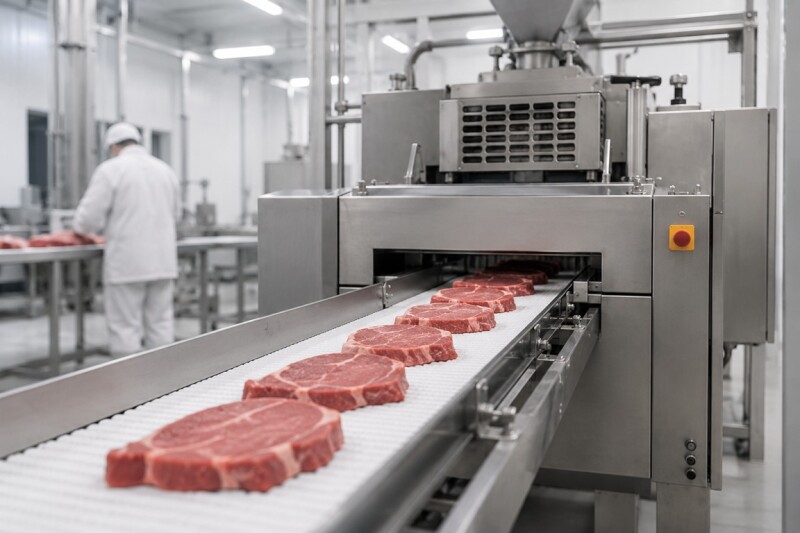
[Article]: Reducing Labor Costs with Advanced Meat Processing Machines
Labor shortages and rising workforce expenses continue to challenge meat processors of all sizes. To remain competitive, many facilities are investing in meat processing machines that streamline operations, improve productivity, and reduce dependence on manual labor. Modern equipment not only helps processors control costs but also enhances product consistency, food safety, and overall efficiency.
The Growing Need for Automation
The meat processing industry has traditionally relied on skilled workers to perform tasks such as grinding, mixing, pumping, portioning, and transferring products throughout the production line. However, labor costs have steadily increased, and finding qualified employees has become more difficult.
Advanced meat processing machines help bridge this gap by automating repetitive and labor-intensive tasks. Instead of assigning multiple employees to handle product movement or processing functions, facilities can use specialized equipment to complete these tasks faster and with greater accuracy.
Increasing Production Efficiency
One of the biggest advantages of modern meat processing machines is their ability to increase throughput without requiring additional personnel. Automated systems can process large volumes of product continuously, reducing bottlenecks and maximizing production capacity.
For example, mixer grinders, positive displacement pumps, and material handling systems can move products efficiently from one stage of processing to the next. This eliminates unnecessary manual handling while keeping production lines running smoothly.
As a result, facilities can produce more products in less time while maintaining a lean workforce.
Reducing Repetitive Manual Tasks
Many tasks within meat processing facilities involve repetitive movements that can be physically demanding for workers. These activities often contribute to employee fatigue, reduced productivity, and workplace injuries.
Modern meat processing machines can automate these repetitive functions, allowing employees to focus on higher-value responsibilities such as quality control, equipment monitoring, and process management.
Improving Product Consistency
Manual processing can introduce variations in product quality due to differences in worker techniques and performance. Advanced meat processing machines are designed to operate with precision, ensuring consistent product size, texture, and composition.
This consistency reduces product waste and minimizes the need for rework, both of which contribute to lower operating costs. When equipment performs tasks accurately every time, facilities can achieve higher yields and improve profitability.
Supporting Food Safety Compliance
Food safety remains a top priority in meat processing operations. Automated equipment often incorporates sanitary designs that make cleaning and maintenance easier. Many modern meat processing machines are built with smooth surfaces, fewer crevices, and easy-access components that support thorough sanitation procedures.
By simplifying cleaning processes and reducing direct product handling, processors can strengthen food safety programs while decreasing labor requirements associated with sanitation activities.
Long-Term Cost Savings
Although investing in advanced equipment requires upfront capital, the long-term benefits often outweigh the initial expense. Reduced labor costs, increased productivity, improved product quality, and lower waste levels can generate significant returns over time.
Facilities that strategically implement meat processing machines are better positioned to adapt to labor market challenges while maintaining efficient and profitable operations.
Conclusion
As labor costs continue to rise, automation has become an essential strategy for meat processors seeking greater efficiency. Advanced meat processing machines help reduce workforce demands, improve consistency, enhance food safety, and increase production capacity. By embracing modern processing technology, facilities can build a more sustainable operation while remaining competitive in an evolving industry.











Interested? Submit your enquiry using the form below:
Only available for registered users. Sign In to your account or register here.