





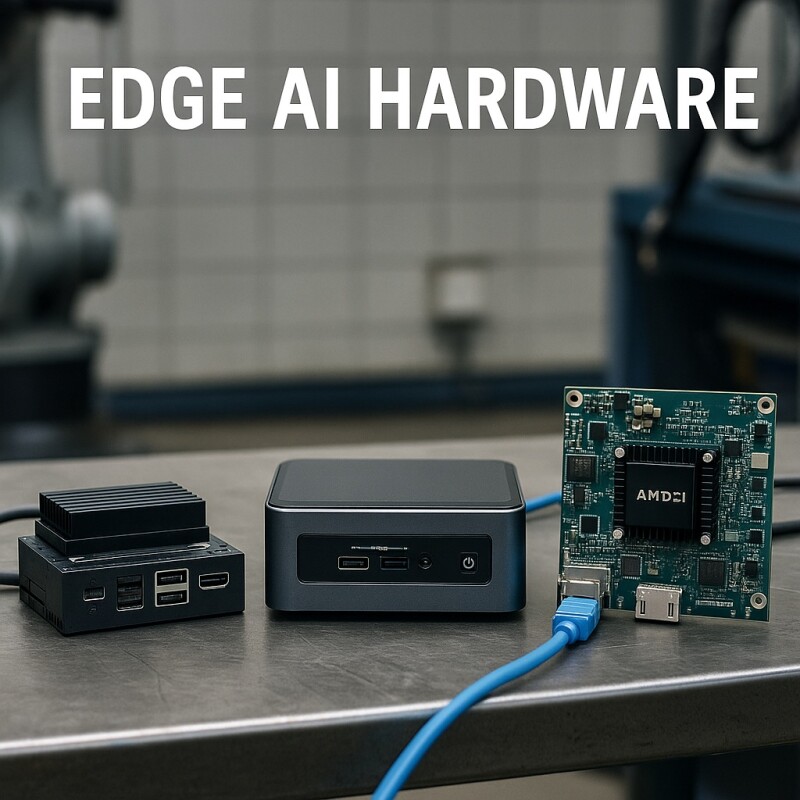
Jetson, OpenVINO, or ROCm? Selecting Edge AI Hardware for Vision and Robotics
Running AI in production isn’t just about models—it’s about hardware. In 2025, three main ecosystems dominate the edge AI landscape: NVIDIA Jetson, Intel OpenVINO, and AMD ROCm. Each offers different trade-offs in cost, performance, and ecosystem maturity. Choosing the right one depends on your use case, from machine vision to autonomous robots.
1. NVIDIA Jetson: The GPU Powerhouse
Jetson platforms (Nano, Orin NX, AGX) excel at parallel inference and GPU-heavy models like CNNs and transformers. They support TensorRT, CUDA, and DeepStream—ideal for vision QA and robotics.
- Pros: Mature ecosystem, strong SDKs, robust camera interfaces, massive developer base.
- Cons: Higher power draw (15–60W), supply chain variability, closed-source drivers.
2. Intel OpenVINO: Balanced Performance and Compatibility
OpenVINO targets Intel CPUs, GPUs, and VPUs (e.g., Movidius). It optimizes ONNX and TensorFlow models for deterministic inference with low latency. Excellent for mixed workloads in environments where x86 already dominates.
- Pros: Integrates with existing industrial PCs, excellent thermal stability, low integration effort.
- Cons: Limited GPU acceleration for large CNNs, slower roadmap for vision accelerators.
3. AMD ROCm: The Open-Source Challenger
ROCm provides open drivers and strong performance for AI workloads on AMD GPUs and embedded devices. It’s emerging in factories adopting open architectures and Linux-first deployments.
- Pros: Fully open-source stack, strong FP16/FP32 performance, cost-effective.
- Cons: Smaller community, fewer ruggedized hardware options.
Performance Comparison (2025 Benchmarks)
| Platform | FP16 Inference (ResNet-50) | Power Draw | Notes |
|---|---|---|---|
| Jetson Orin NX | ~450 FPS | 25W | Best for real-time vision |
| Intel Core i7 + OpenVINO | ~230 FPS | 45W | Best for general purpose PCs |
| AMD ROCm Embedded | ~310 FPS | 35W | Open-source and scalable |
Selection Criteria
- Latency-critical: Jetson + TensorRT
- Mixed control + vision: Intel + OpenVINO
- Open ecosystem & cost: AMD + ROCm
Industrial Deployment Tips
- Use passive cooling and SSD storage in harsh environments.
- Enforce thermal throttling limits via BIOS or OS.
- Containerize deployments for version control (see Containerized OT).
Related Articles
- Edge AI vs Cloud AI for Manufacturing: Where Each Wins in 2025
- Build vs Buy: Choosing Edge Inference Runtimes for Harsh Environments
- Containerized OT: Running AI Safely Next to PLCs
Conclusion
There’s no universal winner. Jetson dominates deep vision, OpenVINO excels in integration, and ROCm offers flexibility. The best choice aligns with your workload, maintenance culture, and hardware roadmap—because in industrial AI, longevity beats benchmarks.














Interested? Submit your enquiry using the form below:
Only available for registered users. Sign In to your account or register here.