



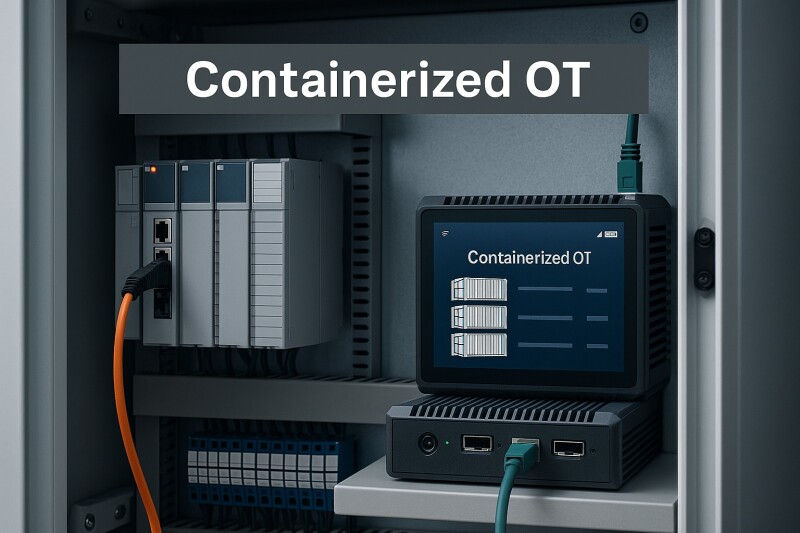
Containerized OT: Running AI Safely Next to PLCs
Traditionally, PLCs operated in deterministic environments while IT workloads stayed far away. But with Edge AI now analyzing sensor data and vision feeds directly beside PLCs, containerization has become the safest way to deploy modern AI workloads on the shop floor.
Why Containerization Matters
Containers isolate software modules in lightweight environments that can be deployed, updated, and rolled back independently. In OT systems, this separation allows engineers to run AI inference and analytics without jeopardizing deterministic control logic.
Architecture Overview
A typical containerized OT system includes:
- Real-time layer: PLCs and motion controllers using deterministic Ethernet.
- Edge compute layer: Industrial PC running Docker or Podman on a real-time Linux kernel.
- Service bus: OPC UA Pub/Sub or MQTT for data exchange with strict QoS policies.
Isolation Strategies
- Use separate CPU cores for AI containers and control tasks.
- Apply read-only access to PLC data via OPC UA.
- Leverage AppArmor or SELinux for runtime confinement.
- Employ health checks and watchdog services for self-recovery.
Common Use Cases
- AI vision models identifying defects and sending results to PLCs.
- Energy optimization services predicting idle zones.
- Condition monitoring models running parallel to process control.
Case Example: Tire Manufacturing Line
An automotive tire plant deployed containerized Edge AI modules next to its PLCs. Each module ran inference on vibration and pressure data to detect mold wear. Containers updated via OTA every month, without interrupting control logic. Uptime reached 99.95%, and energy use dropped 7%.
Governance and Cybersecurity
OT containerization requires explicit security boundaries:
- Network segmentation: Separate VLANs for AI, PLC, and cloud access.
- Signed containers: Verify image authenticity before deployment.
- Offline fallback: Ensure AI services degrade gracefully if disconnected.
Related Articles
- Build vs Buy: Choosing Edge Inference Runtimes for Harsh Environments
- Jetson, OpenVINO, or ROCm? Selecting Edge AI Hardware for Vision and Robotics
- OPC UA over TSN Explained: Determinism Without Vendor Lock-In
Conclusion
Containerization bridges IT and OT safely. It enables frequent AI updates near critical control systems without downtime or interference. By adopting DevOps-style deployment in industrial environments, manufacturers gain flexibility without sacrificing determinism.











Interested? Submit your enquiry using the form below:
Only available for registered users. Sign In to your account or register here.