





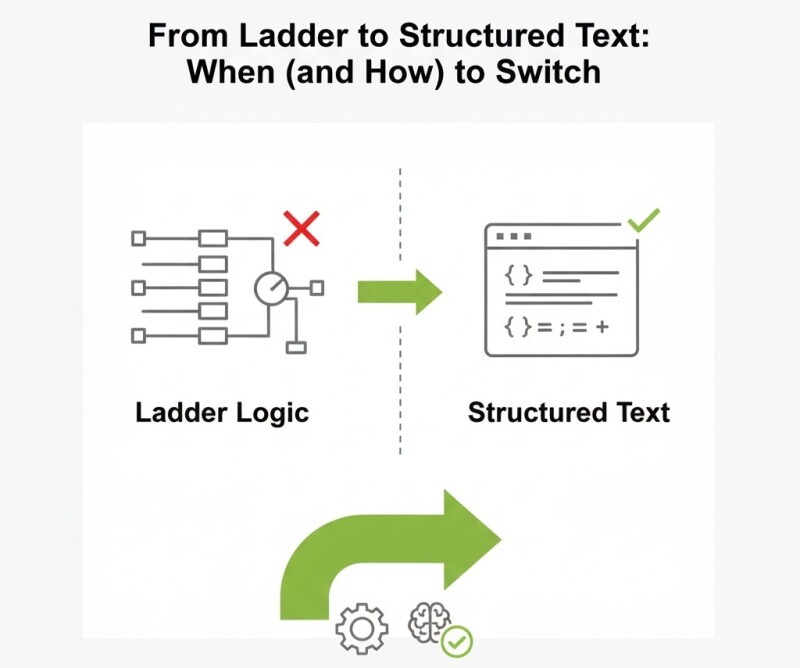
From Ladder to Structured Text: When (and How) to Switch
Ladder Logic has served automation engineers for decades, but modern systems increasingly demand more modular and data-driven code. That’s why many teams are migrating to Structured Text (ST), one of the core IEC 61131-3 languages designed for scalability and integration.
Why Move Away from Ladder?
- Complex logic blocks become hard to visualize or debug.
- Reusability is limited — code cannot easily be parameterized.
- Interfacing with higher-level systems (e.g., MES, AI modules) requires structured data handling.
Advantages of Structured Text
- Maintainability: Functions and classes make updates safer.
- Flexibility: Easier math operations, loops, and state machines.
- Interoperability: Clean integration with OPC UA, MQTT, and analytics tools.
How to Transition
- Start with hybrid projects: Ladder for I/O logic, ST for computation and flow control.
- Train maintenance staff on debugging ST in Codesys or TIA Portal.
- Standardize variable naming and comment structure for readability.
Case Example
An automotive Tier-1 migrated its machine control from 80% Ladder to 60% Structured Text. Average change request implementation time dropped 35%, and error rates during commissioning fell by half.
Related Articles
- IEC 61131-3 Patterns for Maintainable Code
- Open PLCs and Linux-Based Controllers: Pros and Cons
- Version Control for PLC Projects: Git Without the Pain
Conclusion
Ladder Logic won’t disappear, but Structured Text is the future for maintainable and connected automation systems. Start small — and evolve your codebase one function block at a time.















Interested? Submit your enquiry using the form below:
Only available for registered users. Sign In to your account or register here.