


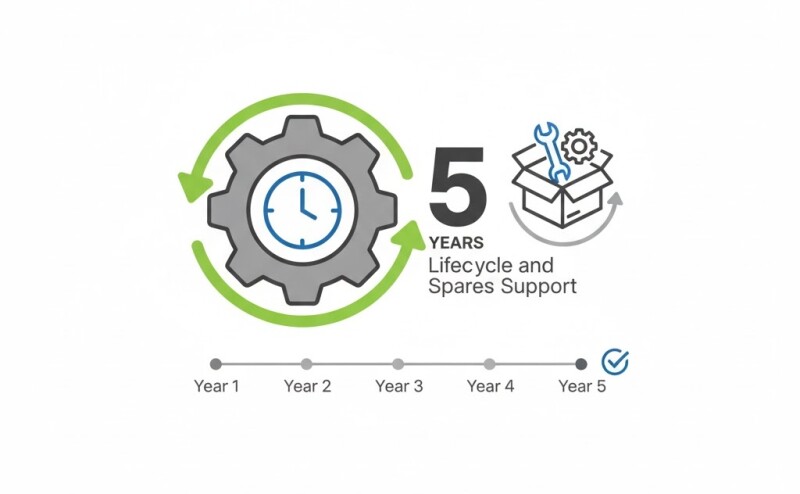
Lifecycle and Spares: Designing for 5-Year Support
Unlike consumer devices, industrial edge hardware must survive long life cycles — often 5–10 years — under harsh conditions. Designing for maintainability and spare availability prevents obsolescence-driven downtime.
Challenges in Industrial Edge Lifecycle
- Component EOL (end-of-life) every 18–24 months.
- Supply chain volatility for embedded GPUs and SSDs.
- Firmware and driver updates breaking backward compatibility.
Designing for Longevity
- Standardize SKUs: Use consistent CPU/GPU models across plants.
- Vendor roadmaps: Choose suppliers with 5- to 7-year lifecycle guarantees.
- Image management: Maintain golden OS builds for redeployment.
Spares Strategy
- Keep 10–15% spare ratio for critical edge nodes.
- Pre-stage replacements with pre-loaded firmware and certificates.
- Label and document spare usage per asset ID for traceability.
Case Example
A Tier-1 robotics integrator cut downtime by 40% by maintaining standardized Jetson spares and a version-controlled OS image vault. Deployment swaps took under 15 minutes.
Related Articles
- GPU Sharing at the Edge: Containers and Scheduling
- Real-Time Considerations: Determinism Next to AI
- Thermals, Enclosures, and Dust: Designing Rugged Edge Nodes
Conclusion
Edge AI is a long-term investment. Designing for lifecycle, spares, and firmware continuity keeps factories running — long after the first deployment is forgotten.














Interested? Submit your enquiry using the form below:
Only available for registered users. Sign In to your account or register here.