





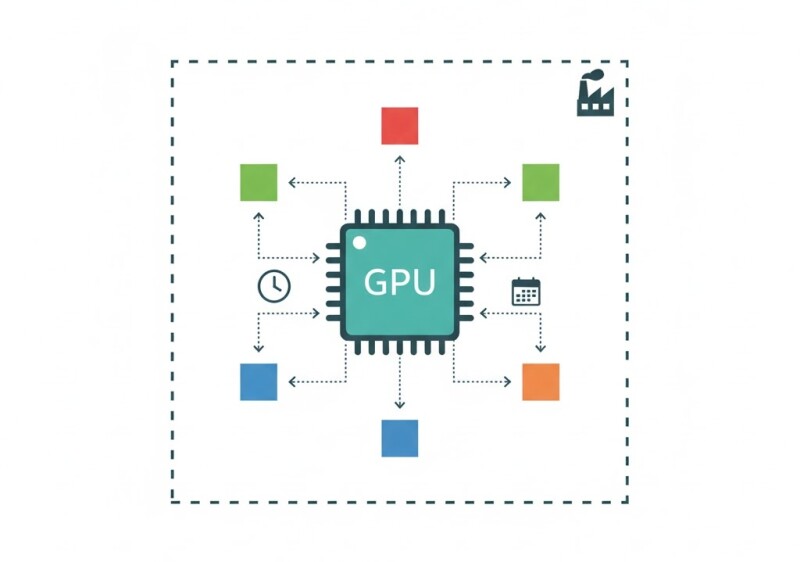
GPU Sharing at the Edge: Containers and Scheduling
Edge AI platforms are getting more powerful — but GPUs remain expensive. To maximize utilization, engineers are turning to containerized AI workloads with GPU scheduling to share compute resources across applications safely.
Why GPU Sharing Matters
- One edge device can host multiple AI models (vision, anomaly detection, etc.).
- Scheduling prevents resource starvation when multiple containers compete.
- Improved ROI by consolidating hardware across production lines.
Containerization Approaches
- Docker + NVIDIA Container Runtime: Simplifies GPU access per container.
- Kubernetes with device plugins: Allocates fractional GPU resources.
- Micro-VMs or LXD: Add security isolation for mixed-vendor models.
Scheduling Techniques
- Static allocation: Fixed GPU shares per workload.
- Dynamic scheduling: Uses telemetry to assign GPU time based on load.
- Priority queueing: Ensures critical inference gets first access.
Example Deployment
A packaging OEM deployed three vision AI models on one Orin NX. With Docker containers and MIG partitioning, GPU utilization hit 87% average, while latency stayed under 12 ms.
Related Articles
- Real-Time Considerations: Determinism Next to AI
- Thermals, Enclosures, and Dust: Designing Rugged Edge Nodes
- Lifecycle and Spares: Designing for 5-Year Support
Conclusion
Sharing GPUs at the edge combines economics and engineering. Containerized AI pipelines deliver high utilization, modularity, and maintainability — all without compromising determinism.















Interested? Submit your enquiry using the form below:
Only available for registered users. Sign In to your account or register here.