





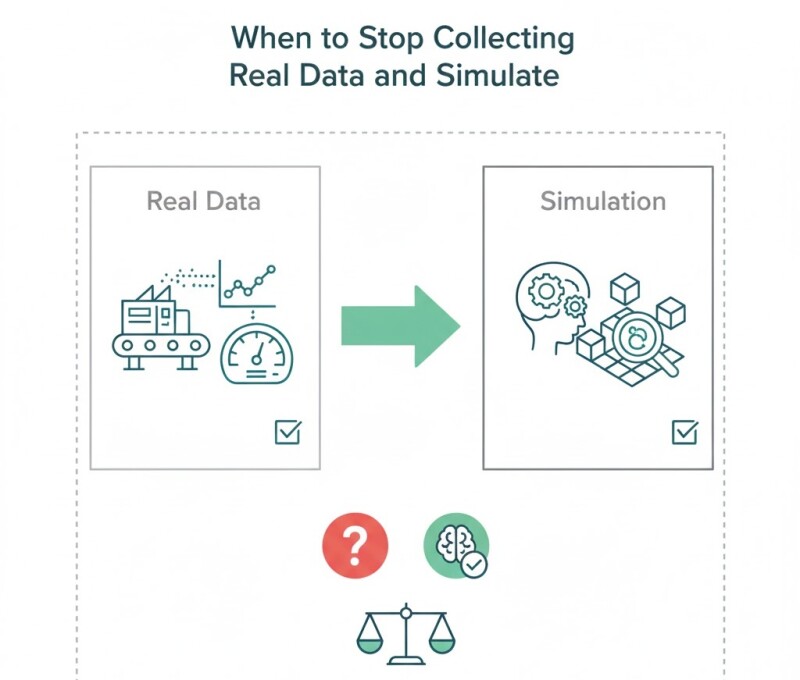
When to Stop Collecting Real Data and Simulate
At some point, gathering more real data stops improving your model — and starts wasting time. Knowing when to switch from physical data collection to synthetic simulation is both an art and a science.
Signs You’ve Reached Diminishing Returns
- Model accuracy plateaus despite new samples.
- Defect rarity makes collection cost-prohibitive.
- Environmental variation exceeds what the line can reproduce safely.
Strategic Transition to Simulation
- Use real data to build the base model (feature extraction, calibration).
- Switch to synthetic data for expansion and stress testing.
- Validate periodically with a small, fresh real dataset.
Hybrid Data Mix
Best-performing models typically use 70–80% synthetic and 20–30% real data. The real portion anchors realism; synthetic covers edge conditions and lighting drift.
Case Example
A packaging plant trained a defect detection network with only 800 real samples. By augmenting with 30,000 synthetic variants, it improved F1-score by 11% and halved labeling costs.
Related Articles
- Domain Randomization for Robustness: A How-To
- Generating Synthetic Defects That Transfer to Reality
- Validating Synthetic Pipelines: Metrics That Matter
Conclusion
Real data grounds your model; synthetic data grows it. The balance point is when incremental real samples cost more than the insight they bring.















Interested? Submit your enquiry using the form below:
Only available for registered users. Sign In to your account or register here.