





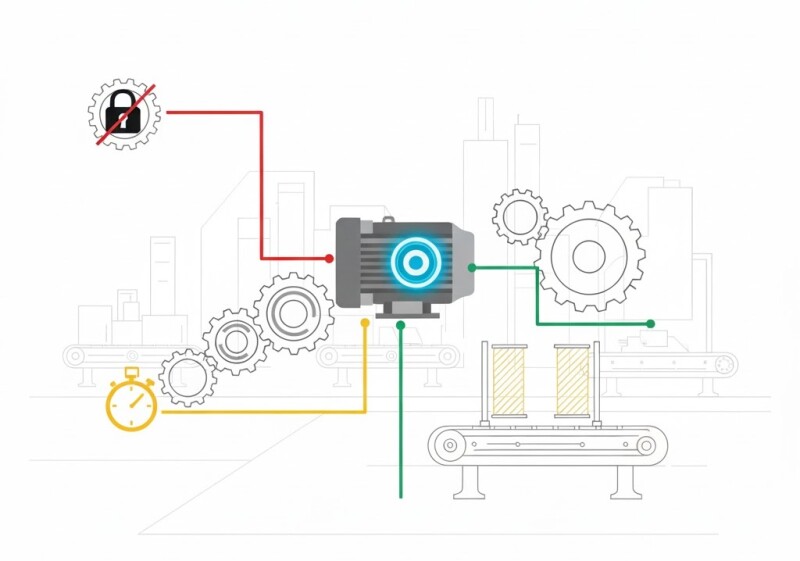
Validating Safe Motion: STO, SS1, SLS, and SSM
Modern drives don’t just stop — they stop safely. Functional safety in motion control uses dedicated mechanisms like STO (Safe Torque Off) and SS1 (Safe Stop 1) to meet performance requirements without compromising productivity.
Key Motion Safety Functions
- STO: Cuts torque immediately — SIL 2/3 or PL e typical.
- SS1: Ramps down before STO activation — ideal for inertia loads.
- SLS: Monitors speed and halts when limit exceeded.
- SSM: Signals safe motion status for coordinated actions.
Validation Process
- Verify stop times with instrumentation (brake timing, encoder feedback).
- Confirm wiring, safety relay, and PLC configuration match safety datasheets.
- Record functional test results and include them in the safety file.
Example
A robot cell implemented SS1 and SLS via a safety drive. Validation confirmed stopping time within 180 ms under full load, achieving PL e / SIL 3 certification.
Related Articles
- PL and SIL Without Tears: Selecting Safety Functions
- Safety PLCs vs Relays: When Each Makes Sense
- Proof Testing Intervals That Don’t Kill Uptime
Conclusion
Safe motion validation isn’t paperwork — it’s proof. Measuring real stop performance ensures safety functions do what the standards promise, every time.















Interested? Submit your enquiry using the form below:
Only available for registered users. Sign In to your account or register here.