





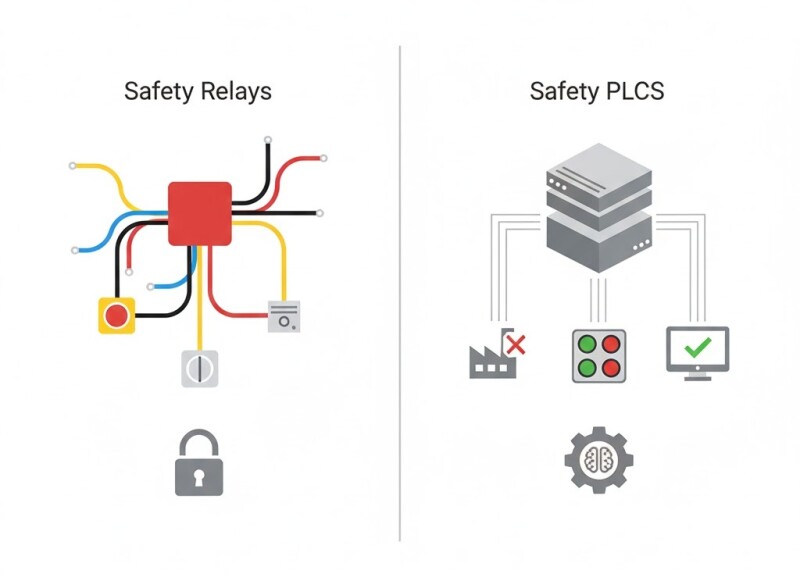
Safety PLCs vs Relays: When Each Makes Sense
Both safety relays and safety PLCs can implement safety functions like emergency stops, guard monitoring, or two-hand control. The right choice depends on complexity, flexibility, and future expansion — not just price.
When to Use Safety Relays
- Few safety functions (typically ≤3).
- Simple wiring and no logic combinations required.
- Standalone machines with fixed hardware configuration.
When to Use Safety PLCs
- Multiple safety zones or configurable logic.
- Integration with standard PLCs or motion controllers.
- Need for diagnostics, networking, and remote monitoring.
Cost vs Capability
Relays are inexpensive but inflexible. Safety PLCs cost more upfront but reduce panel rewiring, commissioning time, and downtime from rework. Lifecycle ROI often favors PLCs when modifications are likely.
Example
A packaging OEM switched from 12 relays to one modular safety PLC. Wiring reduced by 40%, and reconfiguration for new product formats took minutes instead of days.
Related Articles
- PL and SIL Without Tears: Selecting Safety Functions
- Validating Safe Motion: STO, SS1, SLS, and SSM
- Common Cause Failures: What Your FMEA Must Include
Conclusion
Safety relays protect individual machines; safety PLCs protect modular systems. Choose based on system evolution, not just initial simplicity.















Interested? Submit your enquiry using the form below:
Only available for registered users. Sign In to your account or register here.