


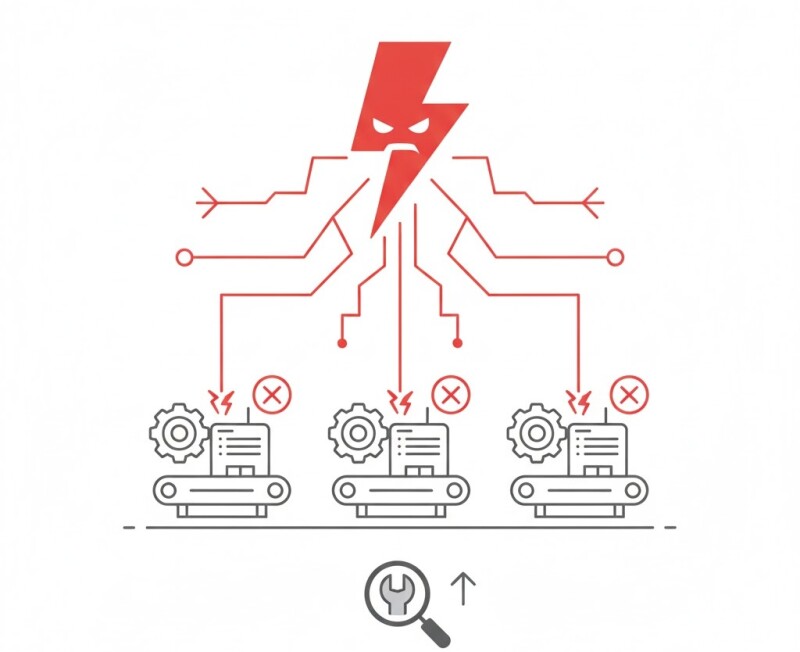
Common Cause Failures: What Your FMEA Must Include
Redundancy only works when failures are independent. Common cause failures (CCFs) — where multiple channels fail for the same reason — can silently erode your safety integrity if not addressed in design and FMEA.
Typical Common Causes
- Shared power supply or grounding faults.
- Mechanical vibration affecting multiple sensors.
- Incorrect configuration copied across redundant controllers.
- Environmental stress (temperature, dust, humidity) beyond spec.
Quantifying CCF Risk
Both ISO 13849 and IEC 62061 include guidance for scoring CCF using the β-factor method. A β of 0.05 (5%) is achievable with physical separation, diversity, and good maintenance.
Design Mitigations
- Separate power supplies and routing paths.
- Use different sensor technologies (optical + mechanical).
- Apply independent software validation or CRC checks.
- Conduct environmental testing to verify robustness.
Example
An automotive press line added isolation between redundant light curtains after detecting EMI interference as a shared failure path. The updated FMEA reduced β from 0.15 to 0.05.
Related Articles
- Safety PLCs vs Relays: When Each Makes Sense
- PL and SIL Without Tears: Selecting Safety Functions
- Proof Testing Intervals That Don’t Kill Uptime
Conclusion
Redundancy isn’t safety unless CCF is under control. Your FMEA must prove independence, not just duplication.














Interested? Submit your enquiry using the form below:
Only available for registered users. Sign In to your account or register here.