




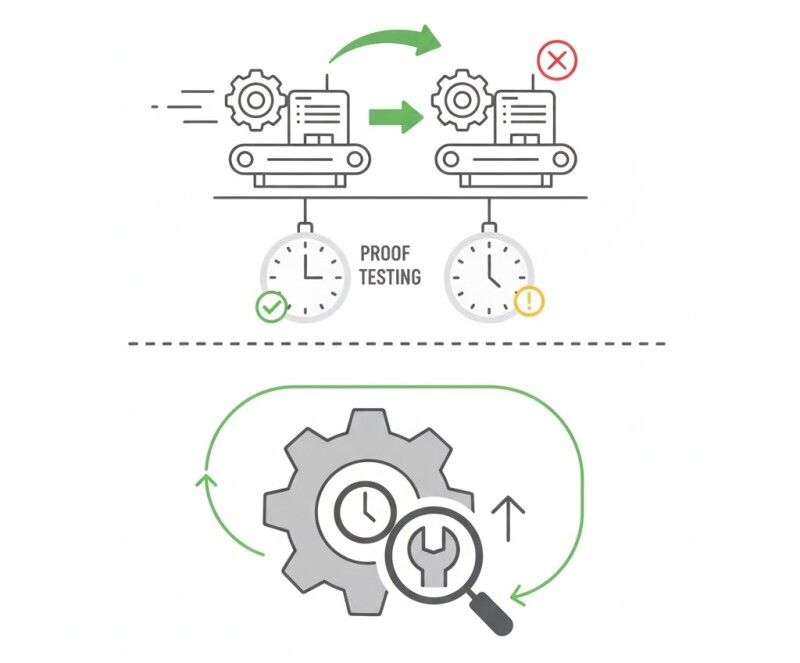
Proof Testing Intervals That Don’t Kill Uptime
Proof testing ensures that safety systems still meet their intended performance — but excessive downtime can make compliance unrealistic. The art lies in balancing test frequency, coverage, and operational impact.
What Proof Testing Means
A proof test verifies that the safety function detects dangerous failures not found during operation. The interval (Tₚ) directly affects the probability of failure on demand (PFD).
Optimizing Test Frequency
- Shorter intervals → lower PFDavg → higher SIL/PL integrity.
- Longer intervals → higher uptime but more accumulated risk.
Strategies to Reduce Downtime
- Perform staggered tests per zone, not full-plant shutdowns.
- Integrate diagnostic coverage (DC) to extend intervals.
- Automate proof steps (relay feedback, heartbeat signals).
Example
A process plant extended proof intervals from 6 to 12 months by adding online diagnostics and test counters in the safety PLC, maintaining SIL 2 compliance.
Related Articles
- Common Cause Failures: What Your FMEA Must Include
- Validating Safe Motion: STO, SS1, SLS, and SSM
- PL and SIL Without Tears: Selecting Safety Functions
Conclusion
Proof testing keeps safety real — but smart scheduling and diagnostics make it sustainable. The best SIL is the one you can actually maintain.














Interested? Submit your enquiry using the form below:
Only available for registered users. Sign In to your account or register here.