


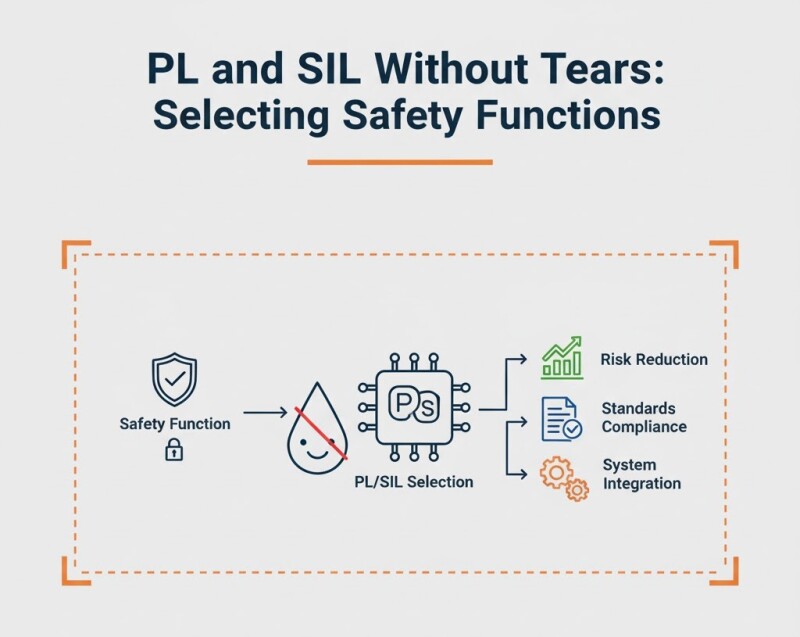
PL and SIL Without Tears: Selecting Safety Functions
Performance Level (PL) and Safety Integrity Level (SIL) are two ways of quantifying how reliable a safety function must be. The challenge for most automation engineers isn’t the math — it’s mapping real-world machinery risks to the right level without over- or under-engineering.
PL vs SIL: The Basics
- PL (ISO 13849): Used for machine safety, based on component categories, MTTFd, and diagnostic coverage.
- SIL (IEC 62061 / IEC 61508): Used for process and functional safety, based on PFHd and hardware fault tolerance.
Selecting the Right Standard
- For discrete manufacturing — use PL.
- For process and continuous systems — use SIL.
- For mixed applications — harmonize both via ISO/TR 23849 cross-referencing.
Step-by-Step Function Selection
- Define the safety function (e.g., “stop motion when guard opens”).
- Assess risk (frequency, severity, avoidance possibility).
- Determine PLr or SIL target using risk graphs or lookup tables.
- Select components (sensors, logic, actuators) that meet the requirement.
Example
A packaging machine’s guard interlock was classified as PL d / SIL 2, using redundant switches and a safety relay. A single-channel stop circuit (PL b) would not have met the required risk reduction.
Related Articles
- Validating Safe Motion: STO, SS1, SLS, and SSM
- Safety PLCs vs Relays: When Each Makes Sense
- Common Cause Failures: What Your FMEA Must Include
Conclusion
PL and SIL don’t need to be intimidating. With a structured approach and proper component data, safety integrity becomes an engineering outcome — not guesswork.












Interested? Submit your enquiry using the form below:
Only available for registered users. Sign In to your account or register here.