





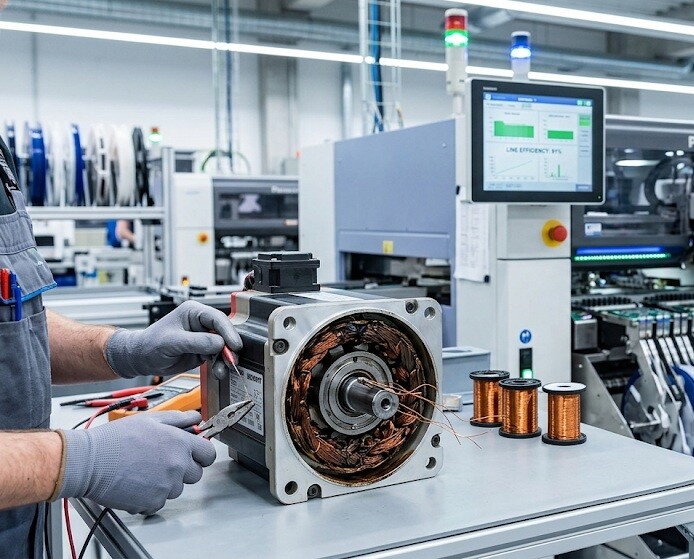
[Article]: The Case for Rewinding Specialized Servo Motors in High Speed Pick-and-Place Lines
High-speed pick-and-place lines are critical in manufacturing because even small interruptions can disrupt throughput goals and downstream processes. When specialized servo motors break, it's sometimes hard to replace them right away, especially given ongoing supply chain issues that make it difficult to find high-efficiency motion parts.
In many circumstances, waiting for a new motor can mean that production schedules cannot handle the extra time off. As a result, rewinding servo motors is becoming a more common way to restore performance while keeping automated systems operational.
Why Replacing a Motor Isn’t Always the Best Option
When things are moving quickly, replacing a broken servo motor is rarely the quickest or most rational option. The reason for this is that teams are thinking about the total cost of ownership (TCO) and supply chain delays when evaluating if rewinding is the best option.
Getting Through the Supply Chain Delays
For automation teams, getting a new servo motor and putting it in the next day is not always as easy as it seems. Even in 2026, industrial automation parts are still hard to find, since many full-motion-control devices rely on layered semiconductor and electronics supply chains that take a long time to reach. For instance, industry data shows that some electronic parts still have average lead times of 26 to 34 weeks and some memory parts take more than 40 weeks.
These delays can soon turn into longer outages on the plant floor. In reality, OEM providers may describe typical drives or PLC modules as taking eight to 12 weeks to deliver. This makes it impossible to replace them right away in many production settings. When specialist servo motors are involved, the time required to replace them can be significantly longer because they need to be customized and integrated with other parts.
Waiting that long has a big effect on how things work. Surveys found that 76% of industrial decision-makers say that unplanned downtime can cost up to $500,000 per hour. Almost half of them say that they have had equipment-related problems at least once a month. In high-speed pick-and-place operations where throughput depends on tightly synchronized motion systems, delays caused by obtaining specialist servo motors can quickly develop from maintenance difficulties into a serious operational and financial risk.
Analyzing Total Cost of Ownership
Because replacement lead times and downtime are so closely related, many automation teams now employ a TCO technique to determine the cost of replacing a servo motor instead of just considering the cost of a new unit. TCO considers the full effect of a choice, including how long repairs will take, how long production will be stopped and the hazards associated with long outages.
When looking at these bigger issues, rewinding specialized electric motors can be a good approach to fix performance problems without stopping production. In locations where pick-and-place is done quickly, cutting downtime is equally critical as keeping equipment costs down.
Top-Rated Electric Motor Rewinding Services
Choosing a qualified rewind service provider is a vital step to avoid downtime and get things back to normal, as servo motor failures can quickly disrupt production schedules. The following organizations are known for providing specialized motor rewinding and repair services to industrial automation teams.
1. Global Electronic Services
Global Electronic Services helps manufacturers fix and rewind industrial motors that use high-speed automation systems. The company's personnel are skilled at inspecting and repairing broken motors, so facilities do not have to wait long for replacements, and the risk of the same problem recurring after previous rewinds is lower.
The company offers a standard three- to five-day turnaround time, rush repair alternatives and 24/7 maintenance assistance. Risk-free evaluations that make it clear what to expect from repairs before they start. A repair price guarantee and a two-year in-service warranty enhance the long-term reliability of its rewind services, making it a good choice for teams that need to get pick-and-place systems back up and running quickly and with confidence.
2. Precision Electric
Since 1983, Precision Electric has helped industrial automation teams by repairing and rewinding servo motors. It focuses on restoring specialized and older motion components used in production settings. The team’s ability to fix things in-house means it does not have to rely as much on outsourced service operations, which can slow down turnaround times when important equipment breaks down.
To help automation systems get back up and running faster, Precision Electric keeps specification records and replacement parts for many old servo motor types. This lets teams fix equipment that could be hard to get replacements through regular replacement channels. This method can help reduce long outages in pick-and-place lines, where compatibility issues sometimes make it harder to replace parts directly.
3. Horner Industrial
Horner Industrial fixes and rewinds industrial motors for factories that use automation and need reliable motion control. The company has been repairing AC and DC motors, servo motors and other parts since 1949. It works with manufacturers to repair broken equipment and keeps systems running smoothly when motors fail unexpectedly.
To make sure that motors are ready to go back to work as quickly as possible, Horner Industrial offers in-house motor rewinding and testing and inspection. It is a good choice for facilities with compatibility issues or that want to prevent long lead times for replacements when specialty motors are hard to find. It knows how to operate with both new and old equipment.
4. Integrated Power Services (IPS)
IPS fixes, rewinds and supports industrial motors and motion-control systems used in harsh production environments. IPS also has service centers throughout North America to help facilities that need speedy repairs when servo motors fail and interrupt the flow of production in automated systems.
Along with fixing servo motors, IPS provides engineering support, predictive maintenance and performance testing to make sure the equipment is reliable before it goes back into service. It has a nationwide service area and experience working with both new and legacy motion components, making it a good choice for teams looking to reduce downtime.
How the Providers Were Selected
These service providers were chosen based on their experience supporting industrial automation environments. The selection focused on companies with capabilities relevant to pick-and-place systems and specialized motion-control equipment. Key evaluation criteria included:
- Showed that they could fix and rewind servo motors used in factories that use automation
- Ability to support unique or older motion-control parts that could be hard to find replacements for
- Availability of testing and inspection in-house to make sure everything works before it goes back into operation
- Ability to help cut down on downtime by offering quick service times or board service coverage
- Reputation for helping factories fix motion-critical equipment that needs repairs
Frequently Asked Questions
Learn more about electric motor rewinding.
Is rewinding an electric motor worth it compared to replacement?
Rewinding can be a good choice when it takes a long time to get a replacement or when keeping production going is important. When deciding whether to rewind or wait for a new motor, it is generally helpful to look at TCO, which includes repair times, compatibility and how it will affect operations.
How long does electric motor rewinding usually take?
The time it takes to finish a regular rewind job depends on the kind and condition of the motor, but it generally takes a few days to a few weeks. Some vendors offer accelerated services that help get specialty motors back to work faster when manufacturing schedules are impacted.
What tests should be performed after an electric motor rewind?
Surge testing, insulation resistance testing and core loss testing are all common tests that are done after rewinding to make sure that the windings are still intact and that the motor is still working well before putting the equipment back into service.
Restoring Motion Performance Without Extended Downtime
When production is at stake, rewind specialist motors are a strong alternative to waiting for new servo motors. By adopting these services, facilities can return to normal more quickly while keeping costs down and avoiding supply chain delays. They can keep important motion systems functioning smoothly and reduce the impact of unanticipated breakdowns on operations.














Interested? Submit your enquiry using the form below:
Only available for registered users. Sign In to your account or register here.