



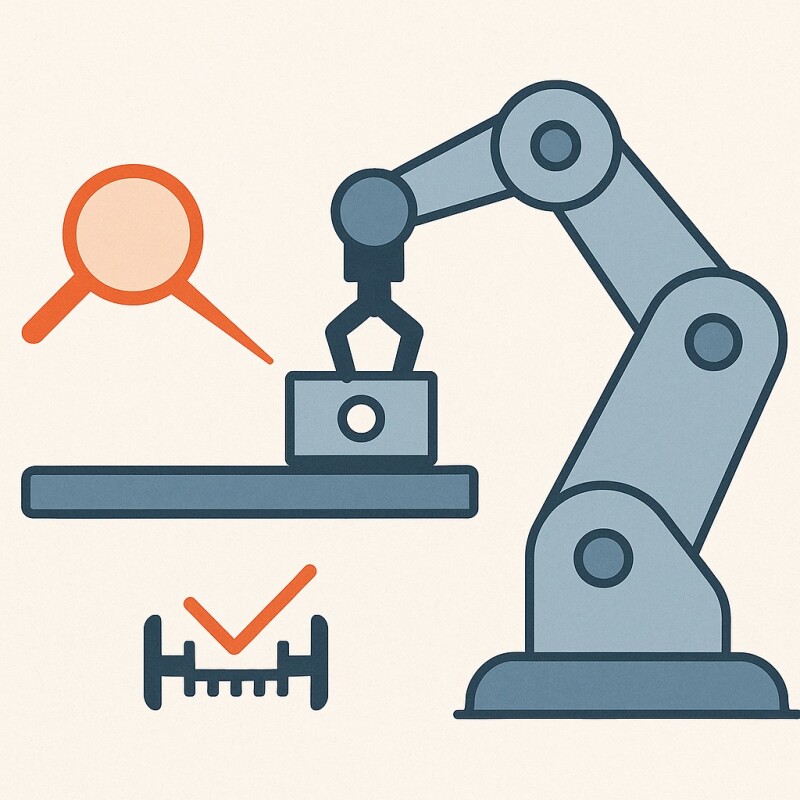
Robots for Tiny Tolerances: Vision and Force Strategies
Electronic assemblies often demand sub-100-micron accuracy. Achieving this repeatably requires coordinated use of high-resolution vision and force-torque feedback — technologies that allow robots to adapt, not just repeat.
Vision Strategies
- 2D fiducial recognition for PCB alignment and connector placement.
- 3D structured light cameras for component pick depth and z-axis correction.
- AI-based pose estimation for deformable or flexible parts.
Force Strategies
- Use compliant motion control with adaptive impedance.
- Set dynamic thresholds based on part geometry.
- Combine tactile sensors with visual feedback for dual verification.
Case Example: Connector Assembly
A robot integrating 3D vision and 6-axis force sensing achieved 98.9% first-pass yield on miniature connectors — previously a manual process requiring magnification tools.
Related Articles
- High-Mix Robotics: Soldering, Dispensing, and Micro-Assembly
- ESD-Safe Automation: What Integrators Forget
- How EMS Providers Automate Without Killing Flexibility
Conclusion
Robots now see and feel better than ever. Combining force feedback with AI-vision alignment delivers the precision electronics demand — without slowing production.












Interested? Submit your enquiry using the form below:
Only available for registered users. Sign In to your account or register here.