


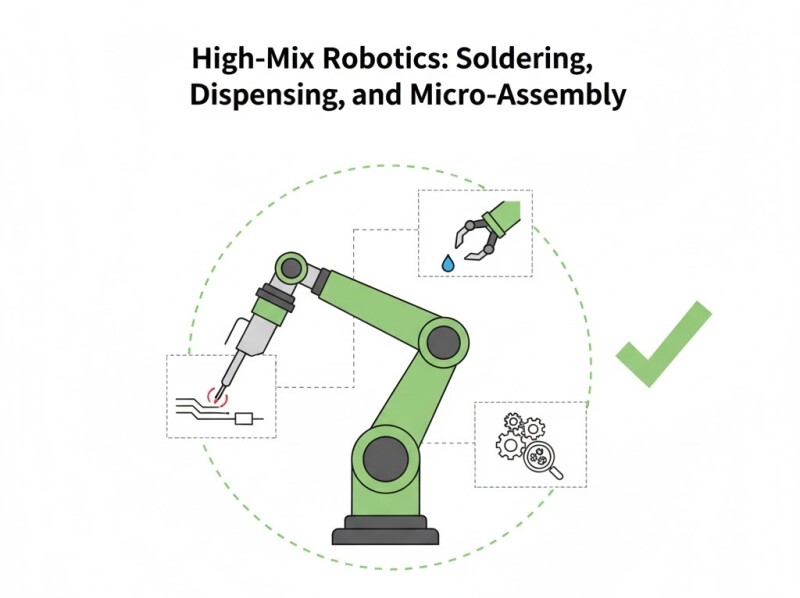
High-Mix Robotics: Soldering, Dispensing, and Micro-Assembly
In electronics manufacturing, high-mix, low-volume production has always challenged automation. Modern robots, however, now combine adaptive motion control, vision feedback, and AI path optimization to handle delicate soldering, dispensing, and assembly tasks once thought impossible to automate efficiently.
Why High-Mix Is Hard
- Frequent product changeovers with different geometries.
- Tooling and fixturing cost amortized over short runs.
- Precision requirements in the tens of microns.
Adaptive Robotics Approaches
- AI-assisted path planning: Automatically adjusts soldering or dispensing paths from CAD data.
- Force-torque sensors: Detect contact on flexible PCBs or connectors.
- Dynamic calibration: Vision systems align parts at each cycle to compensate for drift.
Case Example: LED Assembly Line
A contract manufacturer implemented dual-arm cobots for micro-soldering using dynamic tool offset correction. Cycle times remained under 5 seconds per joint across 14 product variants.
Best Practices
- Integrate CAD-to-path automation early in product introduction.
- Use interchangeable end-effectors for quick retooling.
- Train operators on calibration routines — not code.
Related Articles
- ESD-Safe Automation: What Integrators Forget
- Robots for Tiny Tolerances: Vision and Force Strategies
- How EMS Providers Automate Without Killing Flexibility
Conclusion
High-mix robotics no longer means high risk. With adaptive vision and force feedback, small-batch production gains the same repeatability once reserved for mass manufacturing.














Interested? Submit your enquiry using the form below:
Only available for registered users. Sign In to your account or register here.