


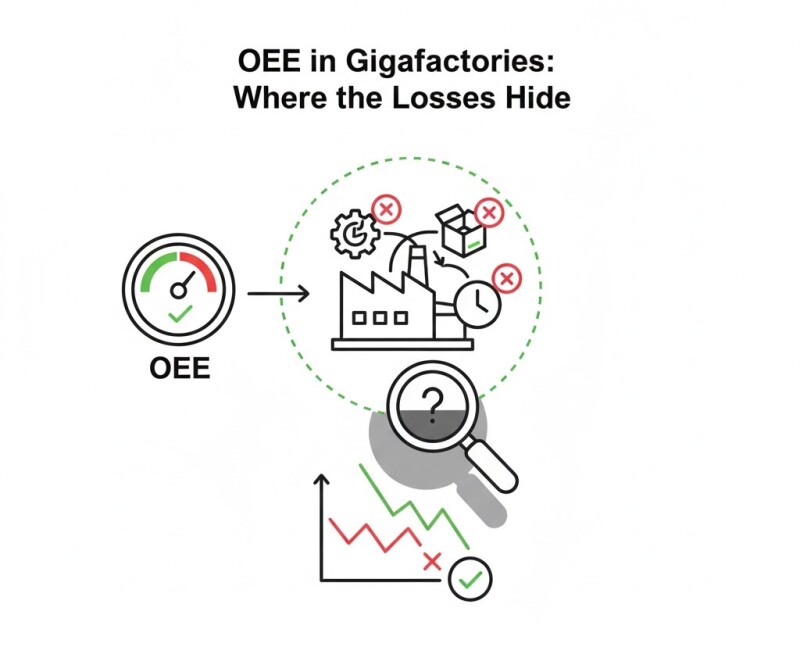
OEE in Gigafactories: Where the Losses Hide
As gigafactories ramp up, Overall Equipment Effectiveness (OEE) becomes the ultimate efficiency benchmark. But in battery manufacturing, traditional OEE often hides real losses behind environmental downtime, yield drift, or quality holdbacks.
Understanding Battery OEE
- Availability: Impacted by dry room maintenance, oven cleaning, or formation cycles.
- Performance: Slurry viscosity or line tension can slow coating or calendaring rates.
- Quality: Inline defects or electrolyte contamination drive scrap and rework.
New Metrics for Gigafactories
- Energy-adjusted OEE: Correlate energy consumption with yield and uptime.
- Material utilization: Track foil and slurry waste as part of the efficiency score.
- Environmental downtime: Account for HVAC and humidity control interruptions.
Digital Tools
Modern MES and historian systems integrate OEE dashboards directly from OPC UA data. AI models detect hidden loss patterns like repeated micro-stops or over-calibrations.
Case Example: Lithium-Ion Gigafactory
By implementing automated OEE tracking with humidity-aware KPIs, a U.S. manufacturer identified 8% hidden downtime caused by dry-room door cycling — and recovered €5M annually.
Related Articles
- Traceability for Cells and Packs: Data from Day One
- Automating Electrode Coating and Dry Rooms: What’s Special
- Quality Control for EV Batteries: From Vision to X-Ray
Conclusion
Gigafactory OEE isn’t about chasing a single number — it’s about uncovering hidden inefficiencies that drain time, energy, and yield. With smart analytics, every loss becomes an opportunity for gain.















Interested? Submit your enquiry using the form below:
Only available for registered users. Sign In to your account or register here.