



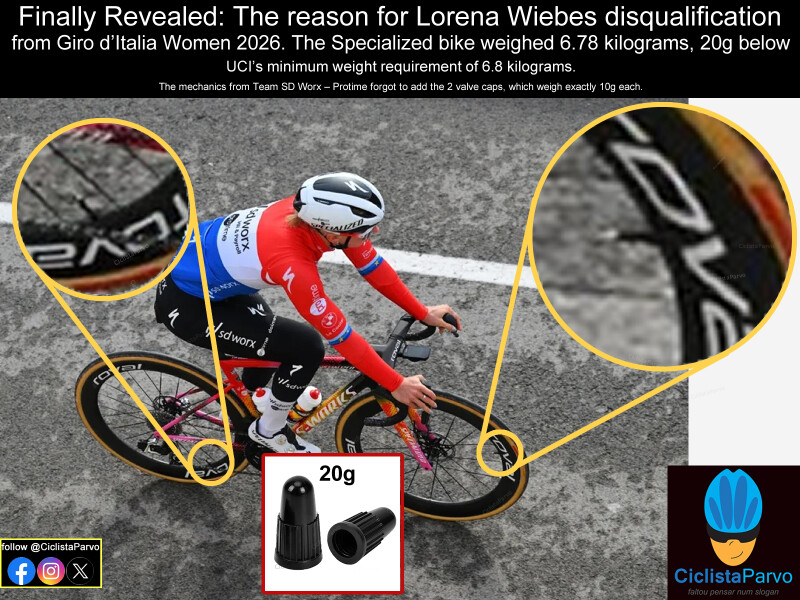
A Viral Internet Meme Raises Awareness of the Importance of Accurate Weighing in Cycling
Lorena Wiebes, the star sprinter from Team SD Worx – Protime, was disqualified after winning the opening stage of the 2026 edition of the Giro d'Italia Women on May 30.
The bicycle used by Wiebes during the stage weighed in at 6.78 kilograms—exactly 20 grams below the Union Cycliste Internationale (UCI) minimum weight requirement of 6.8 kilograms. Consequently, the UCI commissaires' panel excluded her from the race for competing on a non-compliant bicycle under UCI Article 2.12.007–2.2.
Because the bicycle was a mere 20 grams under the limit, the decision triggered immediate controversy throughout the cycling world and beyond.
The 20-Gram Meme That Went Viral
The incident quickly caught the attention of the internet. A satirical meme published by the popular page CiclistaParvo on Facebook joked that the team mechanics simply forgot to screw on the two plastic valve caps, which allegedly weighed exactly the missing 20 grams.

The post exploded, reaching nearly 1 million views in less than 48 hours, generating thousands of reactions, and sparking intense debate. While the valve cap joke was lighthearted, it unintentionally raised serious public awareness about the physical boundaries of sports tech and the sheer weight of a 20-gram margin on an athlete's career.
Metrology Under the Spotlight: Team SD Worx Raises Doubts
Team SD Worx – Protime didn't stay silent. They released an official statement questioning the technical reliability of the measurement process used in Ravenna:
"The team has serious questions about the bicycle-weighing procedures at the Giro d'Italia Women. For example, there was a weight difference of more than 50 grams between the first and second weighing of Wiebes' bicycle after the finish of the stage."
This 50-gram variance on the commissaires' scale shifted the conversation from a team mistake to a question of metrological integrity. In the comment sections of the viral social media posts, fans and tech enthusiasts began asking highly technical questions:
- What was the scale's resolution and precision?
- When was the device last calibrated or certified?
- Were ambient factors (like wind, surface vibration, or residual sweat/moisture on the bike) properly controlled during the official measurement?
The Case for "Legal-for-Sport" Standards
To protect the fairness of any sport, if an official body is going to disqualify an athlete over a margin as small as 0.29% of the total allowed mass, the weighing architecture must be flawless. Devices must be certified, calibrated on-site, and operated under strict legal metrology standards.
As of the publication of this article, the UCI has not released an official breakdown of their scale specifications or the environmental conditions of the protocol that ended Wiebes' Giro campaign.
This incident opens up a broader, necessary debate: just as commercial industries rely strictly on "Legal-for-Trade" certified scales to prevent financial discrepancy, is it time for international athletic federations to adopt a strictly regulated "Legal-for-Sport" metrology framework? When careers hang on 20 grams, measurement integrity isn't just a preference—it's a requirement.
Images Source:
https://www.facebook.com/CiclistaParvo/
















Interested? Submit your enquiry using the form below:
Only available for registered users. Sign In to your account or register here.