





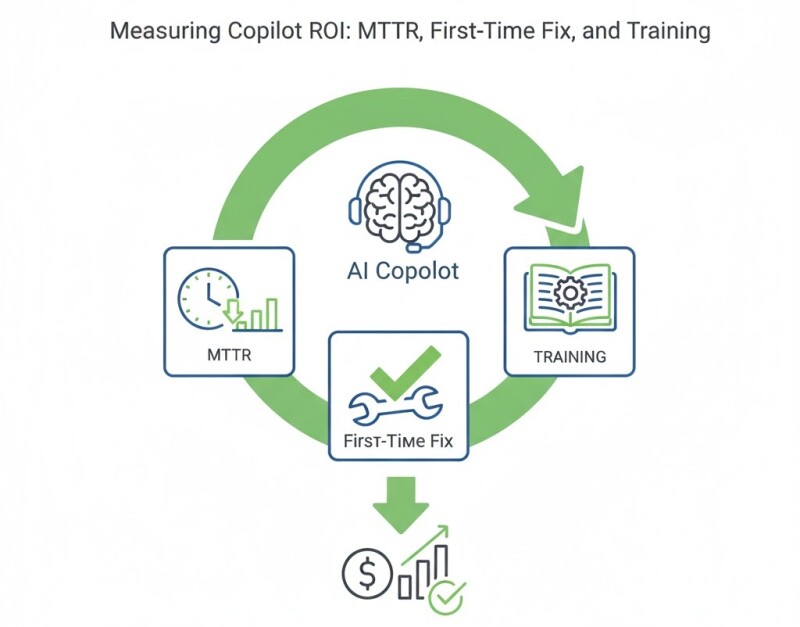
Measuring Copilot ROI: MTTR, First-Time Fix, and Training
AI copilots promise faster troubleshooting, fewer errors, and better onboarding — but how do you prove the return on investment (ROI)? The answer lies in quantifiable KPIs that map AI assistance to operational performance.
1. Mean Time to Repair (MTTR)
Compare repair durations before and after copilot deployment. Plants typically see 15–30% faster fault resolution when copilots suggest verified procedures and parts lists instantly.
2. First-Time Fix Rate (FTFR)
Copilots improve diagnostic accuracy by guiding technicians to root cause on the first attempt. Benchmark FTFR across shifts and asset classes to show reliability improvements.
3. Training Efficiency
Copilots serve as interactive trainers. Tracking time-to-competence for new hires demonstrates AI’s role in accelerated skill transfer and knowledge retention.
4. Qualitative Gains
- Reduced manual documentation lookup time.
- Higher technician confidence and engagement.
- Standardized repair methods across global sites.
Case Example
A food processing firm reported a 28% drop in MTTR and a 40% increase in first-time fix rate after integrating a maintenance copilot across five plants.
Related Articles
- Chunking and Metadata That Make Search Useful
- Human-In-the-Loop QA for Technical Answers
- Safety Guardrails: When Not to Trust the Copilot
Conclusion
Measuring copilot ROI is about connecting metrics to mission: faster recovery, smarter technicians, and consistent knowledge delivery. The payoff is clear — AI copilots turn data into uptime.














Interested? Submit your enquiry using the form below:
Only available for registered users. Sign In to your account or register here.