


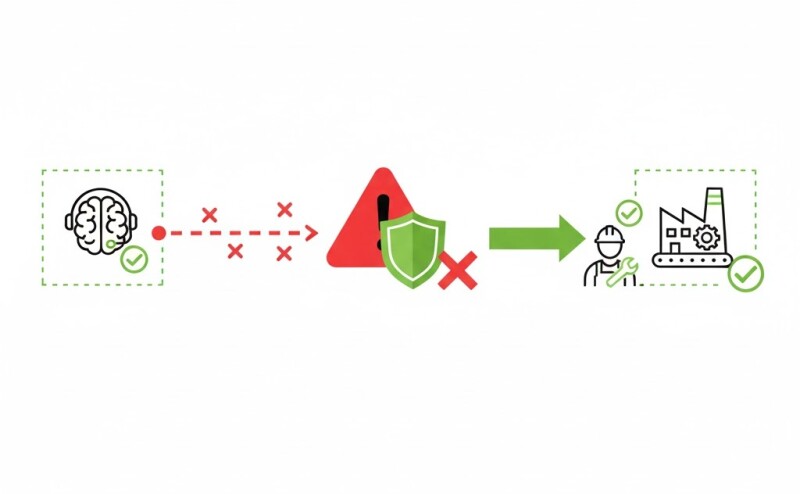
Safety Guardrails: When Not to Trust the Copilot
AI copilots are powerful tools — but they must know their limits. In industrial settings, incorrect guidance can cause safety hazards or regulatory violations. Designing robust guardrails ensures copilots assist responsibly, not autonomously.
Defining Safe Boundaries
- No control actions: Copilots must never send live commands to PLCs, drives, or safety systems.
- Context awareness: Only answer within authorized scope (e.g., maintenance, not process tuning).
- Escalation triggers: Direct the user to a qualified engineer for out-of-bounds queries.
Technical Implementation
- Embed a “safety layer” to classify intent before query execution.
- Use whitelisting for valid data sources and equipment types.
- Integrate human sign-off for high-risk instructions or lockout procedures.
Case Example
An automotive plant limited its copilot’s access to read-only historian data and SOPs. This prevented unsafe suggestions such as altering torque parameters directly from chat prompts.
Governance and Compliance
Every AI deployment should align with IEC 61508, ISO 10218, and NIS2 principles. Documentation of AI boundaries is as important as functional safety validation.
Related Articles
- Human-In-the-Loop QA for Technical Answers
- From PDFs to Answers: Structuring SOPs for RAG
- Measuring Copilot ROI: MTTR, First-Time Fix, and Training
Conclusion
Industrial copilots must be intelligent — but never unsupervised. The safest AI systems know when to defer to human expertise rather than act beyond their scope.












Interested? Submit your enquiry using the form below:
Only available for registered users. Sign In to your account or register here.