





Marrying MES with the Twin: Feedback Loops That Drive OEE
Digital twins and Manufacturing Execution Systems (MES) evolved on parallel tracks—one focused on simulation and design, the other on real-time production tracking. When integrated, they form a powerful feedback loop: the MES feeds the twin with live context, and the twin returns predictive insights that drive continuous improvement in OEE, quality, and throughput.
Why MES and Digital Twins Belong Together
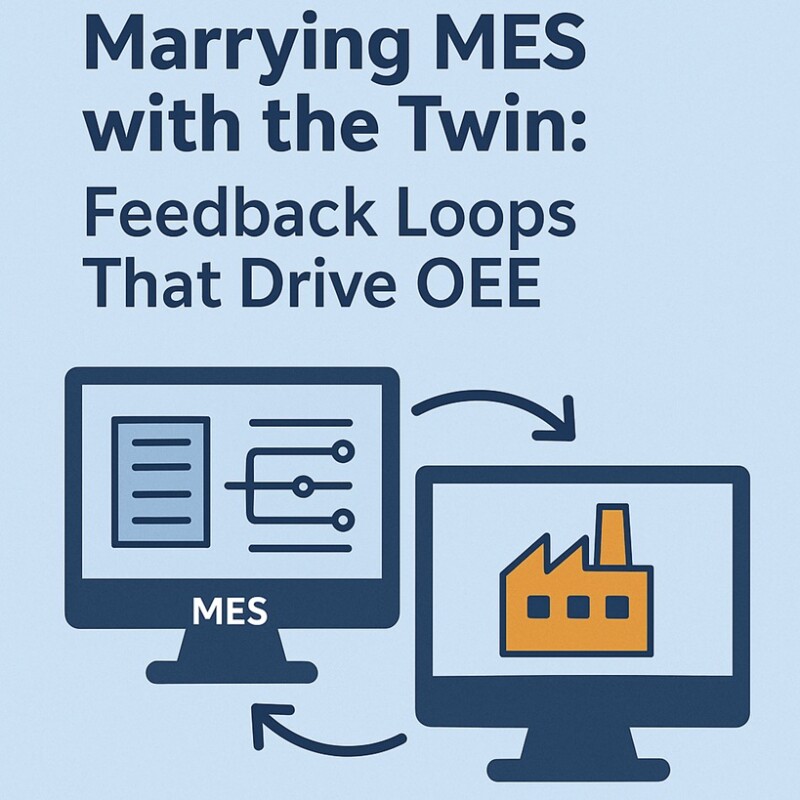
MES manages what is happening now; the twin predicts what could happen next. Without MES data, twins drift away from reality. Without a twin, MES stays descriptive, not prescriptive. Their integration creates a closed loop of perception, prediction, and optimization.
Core Feedback Loop
- Data Capture (MES → Twin): Real-time production orders, resource states, and performance KPIs stream from MES into the twin’s model.
- Simulation & Analysis (Twin → MES): The twin runs “what-if” scenarios or predictive models to suggest parameter adjustments.
- Execution (MES → Shop Floor): Validated recommendations—e.g., new line speeds, staffing changes—feed back to the MES for scheduling.
- Verification (MES → Twin): Actual performance data is compared to simulated expectations, closing the loop.
Typical Integration Architecture
- Layer 1 – Data Collection: PLCs, sensors, and historians feed live tags (via OPC UA or MQTT).
- Layer 2 – MES: Manages production orders, downtime codes, and operator actions.
- Layer 3 – Twin Engine: Runs discrete-event or hybrid simulations, synchronized with live MES data.
- Layer 4 – Analytics Layer: Merges live and simulated KPIs, often using edge gateways or cloud services.
Integration should rely on open information models—OPC UA over TSN for deterministic OT data and REST/GraphQL APIs for MES-level exchange.
Driving OEE Improvements Through Feedback
Overall Equipment Effectiveness (OEE) improves when feedback is both fast and specific. The MES–Twin loop impacts each OEE component:
- Availability: The twin predicts unplanned stops by simulating event sequences based on MES downtime codes.
- Performance: Real vs. simulated cycle times identify micro-stops or speed losses invisible in traditional KPIs.
- Quality: When fed with inspection data, the twin simulates process drift and suggests parameter corrections before defects accumulate.
Case Study: Electronics Assembly Plant
An EMS plant connected its MES (production order tracking) with a logical twin built in a discrete-event simulation tool. The twin used live order queues and station states to simulate takt-time optimization. It recommended station resequencing during shift changes, improving throughput by 11% and reducing changeover loss by 17%. OEE rose from 79% to 86% within two quarters.
Design Considerations
- Latency budget: Feedback under 5 seconds suits short-cycle lines; 1–5 minutes is fine for batch operations.
- Fidelity balance: Logical twins suffice for scheduling and OEE; physics twins only add value for motion or energy studies.
- Security: Harden both systems—use read-only MES APIs for the twin where possible and enforce change approval on feedback loops.
From Descriptive to Prescriptive MES
With a twin in the loop, MES evolves from recording history to recommending actions. For example:
- Predictive scheduling—auto-reorder batches based on simulated completion times.
- Smart downtime classification—map similar downtime clusters to root causes via pattern recognition.
- Dynamic staffing—simulate the impact of absent operators and propose reassignments.
Each suggestion passes through human validation first, keeping control in operators’ hands while accelerating continuous improvement.
Implementation Roadmap
- Week 1–2: Define scope—start with one line and two KPIs (e.g., availability and changeover).
- Week 3–6: Map MES tags and historian data to twin variables; validate timestamps and quality.
- Week 7–10: Run shadow simulations; compare predicted vs. actual performance.
- Week 11–12: Activate advisory feedback (operator-verified suggestions).
- Month 4+: Scale to prescriptive mode with automatic adjustments.
Q&A
Does MES need modification?
No, modern MES platforms already expose APIs and OPC UA connectors. The twin consumes these endpoints—no need for database changes.
How is data synchronized?
Use timestamped events as the common reference. Both MES and twin subscribe to the same event bus for start/stop, quality, and alarm messages.
Who owns the twin?
Operations usually owns it post-deployment, while engineering maintains the logic. Governance should mirror software change control.
Related Articles
- The Practical Digital Twin: What to Model, What to Ignore
- Factory Simulation to Cut Changeover Time: Case-Based Guide
- Virtual Commissioning for Faster Startups: PLC, HIL, and Twin Integration
Conclusion
Integrating MES with digital twins transforms production from reactive to proactive. Live MES data keeps the twin truthful; twin predictions keep MES insightful. This closed feedback loop not only boosts OEE but builds a foundation for autonomous, self-optimizing manufacturing systems.













Interested? Submit your enquiry using the form below:
Only available for registered users. Sign In to your account or register here.