



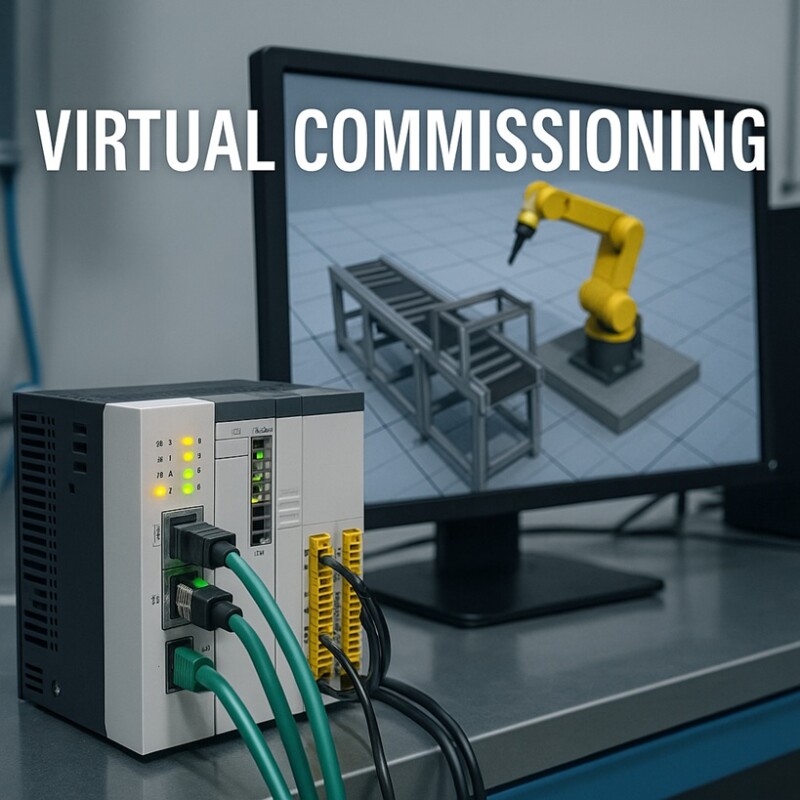
Virtual Commissioning for Faster Startups: PLC, HIL, and Twin Integration
Every hour of delayed production startup costs money. Yet, most automation teams still validate PLC logic and robot programs on the real line—when time and access are limited. Virtual commissioning (VC) changes that by linking the digital twin of a machine or cell with the real control code before hardware is built. The result: faster ramp-up, safer debugging, and repeatable simulation-driven startups.
Why Virtual Commissioning Matters
Virtual commissioning replaces trial-and-error on the shop floor with simulation and structured testing. Instead of waiting for mechanics and wiring to finish, controls engineers connect their PLC, HMI, or robot controller to a simulated model that behaves like the real plant. Bugs are fixed weeks earlier, reducing startup time by 25–50% and minimizing stress on physical assets.
How It Works
A VC environment combines three elements:
- 1. A physics or kinematic twin: Represents the mechanical system—axes, sensors, actuators, conveyors, and material flow.
- 2. The real control code: PLC logic, robot programs, or motion controllers compiled as-is, not reimplemented.
- 3. The I/O bridge: Software or hardware layer mapping PLC inputs/outputs to simulated signals in real time.
The twin and controller exchange data deterministically—ideally via OPC UA over TSN or fieldbus emulation—creating a digital sandbox where engineers can test start/stop sequences, alarms, and safety logic.
Hardware-in-the-Loop (HIL) vs. Software-in-the-Loop (SIL)
Virtual commissioning spans both:
- Software-in-the-Loop (SIL): Runs control logic in a virtual PLC instance. Ideal for early-stage development without physical hardware.
- Hardware-in-the-Loop (HIL): Connects the actual PLC or robot controller via I/O simulation racks or fieldbus gateways. Provides true timing and electrical behavior.
SIL finds logical bugs early; HIL catches timing, scan rate, and safety interlock issues before the first power-up.
Integration Workflow
- 1. Import mechanics: Bring in 3D geometry and motion constraints from CAD or the twin model.
- 2. Define signals: Map sensors, actuators, and safety devices to PLC tags. Include cycle timers, encoders, and limit switches.
- 3. Link controller: Connect real or virtual PLC, and test I/O mapping.
- 4. Execute test plans: Simulate automatic cycles, faults, and E-stop scenarios. Record PLC state changes and response times.
- 5. Validate KPIs: Ensure cycle time, throughput, and safety responses match design specs.
Tools and Platforms
Most vendors offer VC-ready toolchains: Siemens SIMIT, Rockwell Emulate 3D, Schneider EcoStruxure Machine Expert Twin, Dassault DELMIA, Unity Industrial Twin, or open-source frameworks built on Unreal or Gazebo. Choose based on your PLC ecosystem and simulation fidelity requirements.
Key Benefits
- Startup time reduction: 30–50% faster line commissioning due to earlier debugging.
- Safety validation: Verify interlocks and E-stop sequences without physical risk.
- Training: Operators and maintenance staff can train on the virtual cell before the real one is ready.
- Change management: Later updates or retrofits can be tested offline using the same twin model.
Practical Example: Packaging Line Retrofit
A packaging OEM used virtual commissioning to validate PLC updates for a servo-driven carton former. Using a physics-based twin and real PLC hardware in HIL mode, they discovered race conditions and mis-sequenced alarms before the physical rebuild. Commissioning time dropped from 8 days to 3, and the machine started production on the first shift without safety violations.
Integration with Digital Twins
Virtual commissioning is one stage of a twin’s lifecycle. During design, the twin supports feasibility and throughput analysis. During commissioning, it links to controls logic for validation. After startup, it transitions into a live operational twin fed by historian data—forming a continuous feedback loop between simulation and reality (see Practical Digital Twin).
Testing Automation: Continuous Commissioning
Leading plants integrate VC into their MLOps and DevOps pipelines. PLC and robot code commits trigger automated simulation runs in virtual environments—detecting regressions or timing drift early. Combined with model versioning and drift monitoring (MLOps for OT), this ensures continuous validation through the asset’s lifecycle.
KPIs for Virtual Commissioning
- Cycle time deviation: ±5% max vs. design spec.
- Fault coverage: ≥90% of identified scenarios tested virtually.
- Startup delta: Real vs. planned startup duration reduction (%).
- Rework rate: Fewer than 2 PLC code patches post-startup.
Q&A: Common Challenges
Can VC replace real commissioning entirely?
No—physical commissioning is still required for final calibration and hardware verification. VC removes 70–80% of the unknowns, allowing the last 20% to go faster.
How accurate must the model be?
Focus on functional accuracy—sensor states, motion timing, and interlocks. High-polygon CAD adds little unless geometry drives logic.
Can smaller OEMs afford VC?
Yes. Entry-level VC can start with open tools and virtual PLCs. The ROI is strong even for single cells when downtime and travel costs are counted.
Related Articles
- The Practical Digital Twin: What to Model, What to Ignore
- OPC UA over TSN Explained: Determinism Without Vendor Lock-In
- MLOps for OT: Versioning, Drift, and Model Monitoring on the Edge
Conclusion
Virtual commissioning transforms how automation projects start. By linking PLC logic and digital twins before hardware exists, manufacturers cut risk, time, and cost. The most practical implementations stay physics-light, interface-rich, and version-controlled—turning commissioning from a frantic event into a predictable, data-driven process.










Interested? Submit your enquiry using the form below:
Only available for registered users. Sign In to your account or register here.