





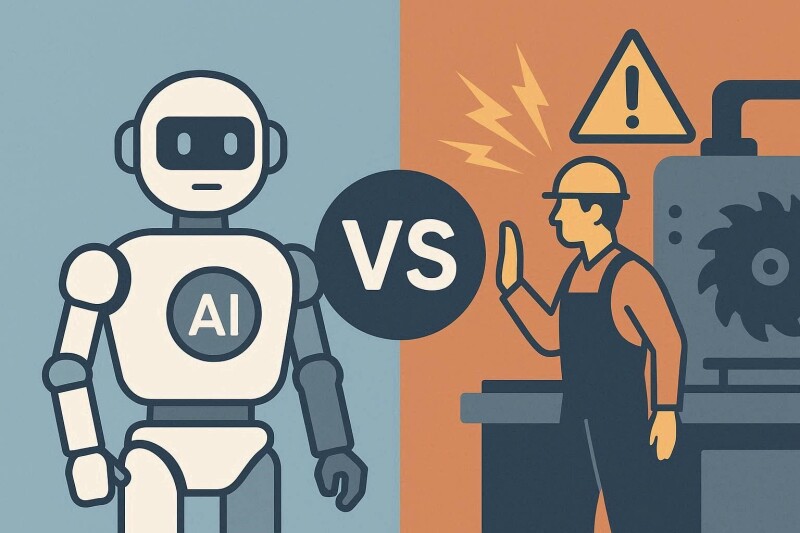
GPAI vs High-Risk in the Plant: What Applies to Your Use Case?
The EU AI Act introduces a new category: General-Purpose AI (GPAI). For manufacturers, understanding whether an AI model counts as GPAI or high-risk determines documentation scope, liability, and vendor responsibilities.
What Is GPAI?
General-Purpose AI refers to models that can be adapted for many applications, such as large vision models or pre-trained foundation models. They’re usually provided by upstream suppliers or cloud vendors.
When GPAI Becomes High-Risk
- If your factory fine-tunes a GPAI model for a regulated task (e.g., defect rejection), it inherits high-risk obligations.
- If you use a GPAI service without modification (e.g., for analytics), the supplier bears primary compliance duties.
How to Classify Your Use Case
- Identify model origin (internal, vendor, or open source).
- Define intended use and whether it affects compliance or safety.
- Check if fine-tuning or retraining changes the model’s purpose.
Responsibility Matrix
| Scenario | AI Type | Who Complies |
|---|---|---|
| Cloud vision API for analytics | GPAI | Vendor |
| Retrained model for defect decisions | High-Risk | Manufacturer |
| Hybrid approach (Edge + Cloud) | Mixed | Shared |
Case Example: Plastic Injection Plant
Using a cloud foundation model fine-tuned for cavity defects, the plant became a co-provider under the AI Act. A shared conformity statement was filed with the vendor.
Related Articles
- EU AI Act for Manufacturing: Is Your Vision System ‘High-Risk’?
- AI Governance for Factories: Policies, Logs, and Human Oversight
- Timeline to Compliance: A Factory’s 12-Month Plan
Conclusion
Determining whether your system is GPAI or high-risk is essential for compliance. Manufacturers must clarify roles early — ideally in supplier contracts — to avoid regulatory ambiguity later.












Interested? Submit your enquiry using the form below:
Only available for registered users. Sign In to your account or register here.