



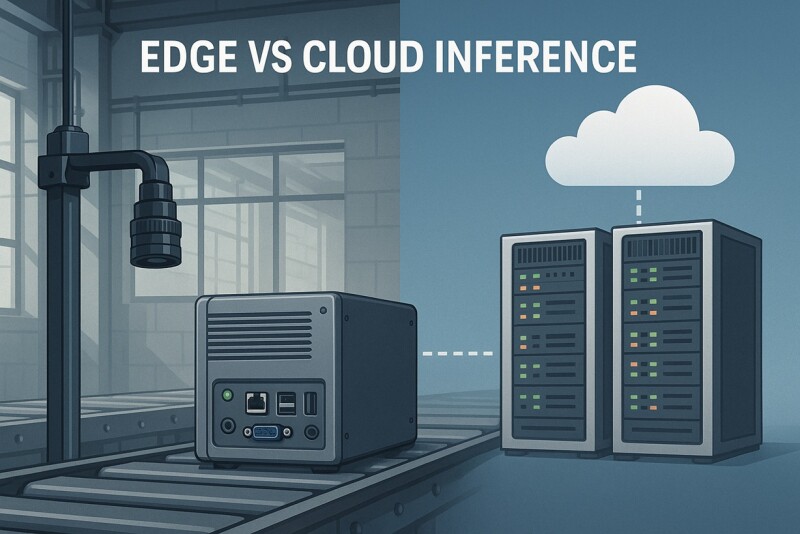
Edge vs Cloud Inference for Vision QA: Latency, Cost, and Accuracy
Computer vision is now a core capability in automated quality assurance (QA). But one architectural decision will determine whether your inspection cells meet cycle time and cost targets: should inference run at the edge (near the camera) or in the cloud? This article gives a pragmatic comparison across latency, bandwidth, cost, accuracy, security, and operations, and proposes a reference blueprint for hybrid deployments.
What We Mean by “Edge” and “Cloud”
Edge inference executes the trained model on an industrial PC (IPC), embedded SoC, or GPU module placed on the line or in a local control room. Cloud inference streams images (or features) to centralized infrastructure for processing. A hybrid approach splits responsibilities: the edge performs real-time classification and I/O, while the cloud aggregates results, retrains models, and orchestrates updates.
In high-speed inspection, milliseconds matter. As covered in Vision AI on the Line, the timing between image capture, inference, and actuator trigger directly affects false reject/accept rates and OEE.
Latency: The First Non-Negotiable
Latency is the wall clock time from exposure to decision. For pick-and-place, packaging, or SMT lines, the practical budget is often <50 ms end-to-end, with inference itself ideally <20 ms.
- Edge: Deterministic, single-digit to tens of ms. No WAN variability. Suitable for hard real-time reject gates and robot handoffs.
- Cloud: Adds network transit (uplink + processing + downlink). Even with excellent connectivity, jitter can exceed the actuator window, forcing rework buffers or slower cycle times.
Rule of thumb: If the inspection decision must trigger an actuator on the same cycle, run inference on the edge.
Bandwidth and Connectivity
Raw industrial camera streams are heavy: a single 5 MP camera at 60 FPS can exceed 1 Gbps uncompressed. Compressing helps, but continuous cloud upload quickly hits limits and costs.
- Edge: Processes locally and publishes only decisions (OK/NOK, class, confidence) plus selected thumbnails. This reduces uplink to kilobytes per event.
- Cloud: Feasible for lower-rate tasks (e.g., sampling, offline analysis) or where fiber is abundant and inexpensive.
For plants with strict network segmentation or intermittent links, the edge avoids operational risk while still allowing periodic synchronization.
Cost Model: CapEx vs OpEx—But Also Data Gravity
Cloud looks inexpensive at pilot scale. At production scale, two factors dominate: egress/storage charges and continuous compute. Conversely, edge requires up-front hardware, but per-cell life cycle costs are predictable.
- Edge-heavy: Pay once for an IPC/SoC + camera interface; minimal recurring infra cost; small telemetry to cloud.
- Cloud-heavy: Lower CapEx, higher OpEx (compute hours, storage, data egress). Attractive for highly variable workloads or shared corporate platforms.
- Hybrid: Edge for hot path; cloud for fleet analytics, dataset curation, and model retraining—typically the best TCO for vision QA.
Back-of-the-envelope: If continuous upload of full-resolution frames is required, cloud OpEx often surpasses an industrial edge GPU within months.
Accuracy and Model Lifecycle
Accuracy depends more on data and training than on where inference runs. However, speed and determinism at the edge allow tighter exposure timing and lower motion blur, which indirectly improves accuracy. The cloud shines in retraining, where scalable compute can ingest new examples quickly—especially in few-shot or class-incremental scenarios.
- Edge strengths: Stable timing, immediate feedback loops, on-line threshold tuning, and quick A/B of light-weight model variants.
- Cloud strengths: Heavy retraining jobs, hyperparameter sweeps, dataset versioning, experiment tracking.
Security, Compliance, and IP Protection
Many manufacturers restrict image egress due to IP sensitivity (new geometries, unreleased SKUs). Edge inference keeps sensitive imagery on-prem while sending only aggregated metrics. If cloud is required, design with tokenized data, encryption at rest/in transit, and strict retention policies. Consider redaction or on-edge feature extraction so no identifying imagery leaves the plant.
Operations: Who Owns What?
OT teams prefer solutions that fit existing maintenance rhythms: spare IPCs, deterministic I/O, and minimal dependencies. IT/Cloud teams prioritize centralized governance, patching, and observability. A good architecture makes both happy:
- Edge runtime: Containerized inference service, hardware watchdog, local metrics, and PLC/robot I/O adapters.
- Cloud control plane: Model registry, signed artifacts, staged rollouts, over-the-air updates, and fleet dashboards.
Reference Architecture (Hybrid)
- Capture: Industrial camera → edge frame grabber/vision SDK.
- Preprocess: Lens/lighting normalization (see hardware guide).
- Edge inference: Optimized model (INT8/FP16), deterministic scheduler (<20 ms budget).
- Actuation: Digital I/O to rejector/robot; timestamped result.
- Telemetry: Summaries + selected crops to cloud data lake.
- ModelOps: Cloud retraining, evaluation, and signed rollout to edge fleet.
Sizing Checklist for Edge Inference
- Target cycle time and frame rate (e.g., 100 parts/min, 2 images/part).
- Model complexity (params, input resolution) and target precision (INT8/FP16).
- Thermal headroom and dust protection for IPC/SoC.
- I/O requirements: trigger, strobe, encoder, reject timing.
- Local storage for short-term image buffers and audit trails.
When Cloud Inference Still Wins
- Non-real-time analysis (end-of-line sampling, batch review, supplier audits).
- Very low image volumes or intermittent inspection.
- Centralized environments with abundant, inexpensive bandwidth and strict global governance.
Decision Matrix
| Criterion | Edge | Cloud | Hybrid |
|---|---|---|---|
| Real-time latency (<50 ms) | ★★★★★ | ★☆☆☆☆ | ★★★★★ (edge handles hot path) |
| Bandwidth sensitivity | ★★★★★ | ★★☆☆☆ | ★★★★☆ |
| Scale retraining | ★★★☆☆ | ★★★★★ | ★★★★★ |
| IP protection | ★★★★★ | ★★★☆☆ (requires redaction) | ★★★★☆ |
| TCO at high throughput | ★★★★☆ | ★★☆☆☆ | ★★★★☆ |
Mini ROI Example
Assume a line with 2 cameras at 30 FPS, 0.75 ms exposure, and a 40 ms actuator window. An edge IPC with an entry GPU delivers 12 ms inference → safe margin for reject. Cloud adds 90–150 ms network round-trip on average—outside the window—forcing buffer stations (CapEx), rework (labor), or slower throughput (lost revenue). Edge saves both productivity and OpEx from continuous data egress.
Q&A: Common Questions
Can we start in the cloud and move to the edge later?
Yes. Design for model portability from day one (ONNX, TensorRT, OpenVINO, etc.). Keep preprocessing identical across environments and track versions.
Do we still need the cloud if inference is at the edge?
For most programs, yes. The cloud remains the best place for dataset curation, retraining, KPI dashboards, and orchestrating safe rollouts.
What about on-prem “private cloud”?
Great option when data cannot leave the site. Treat it like cloud operationally, but remember you still need deterministic edge runtimes for hard real-time cells.
Related Articles
- Few-Shot Learning for Quality Control: When You Don’t Have Enough Data
- Vision AI on the Line: Beating Traditional Rules-Based Inspection
- Lighting, Lenses, and Latency: The Hardware Stack for Reliable Visual QA
Conclusion
If the decision must drive an actuator in the same cycle, choose edge inference. If your priority is elastic compute for retraining and analytics, choose the cloud. In practice, most factories land on a hybrid blueprint: deterministic, low-latency inference at the edge; centralized learning and governance in the cloud. This combination delivers the best balance of latency, cost, accuracy, and operational control for modern visual QA.











Interested? Submit your enquiry using the form below:
Only available for registered users. Sign In to your account or register here.