





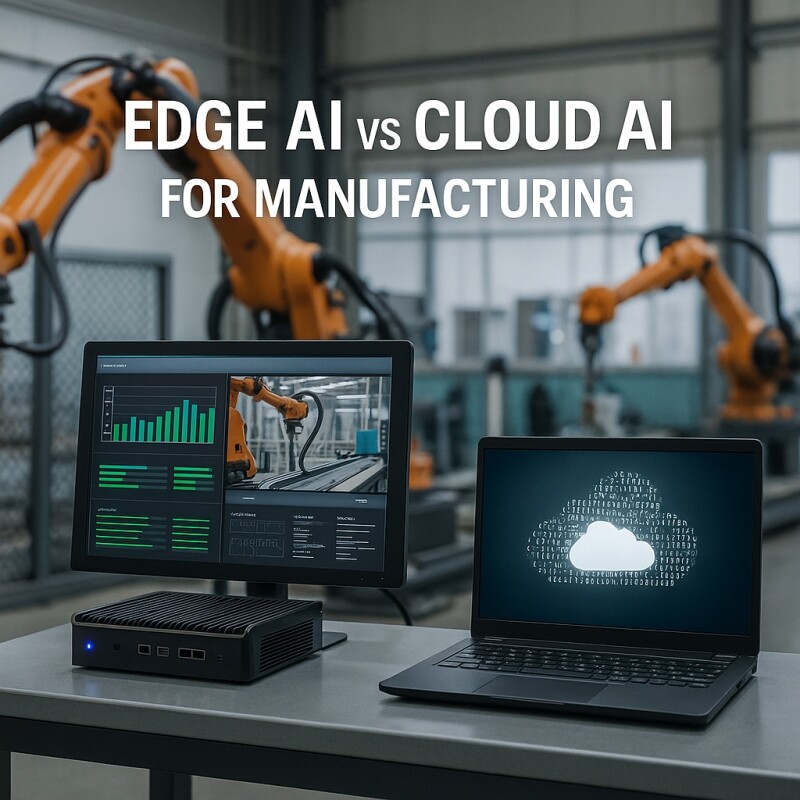
Edge AI vs Cloud AI for Manufacturing: Where Each Wins in 2025
AI in manufacturing is no longer confined to the cloud. The rapid growth of Edge AI—AI processing close to the machine—has reshaped how plants deploy analytics, vision, and control applications. But cloud AI hasn’t disappeared. Instead, smart manufacturers are learning where each technology wins.
Defining Edge vs Cloud AI
Edge AI runs inference on or near the production line using embedded GPUs or industrial PCs. It minimizes latency and network dependence. Cloud AI centralizes training, storage, and global optimization using scalable compute power.
Where Edge AI Wins
- Low latency: Sub-50 ms response for inspection or control.
- Connectivity independence: Operates even during network outages.
- Data privacy: Keeps sensitive production data on-site.
- Cost efficiency: Avoids recurring bandwidth and cloud fees.
Where Cloud AI Wins
- Scalability: Massive datasets for model training.
- Global coordination: Multi-site learning and fleet analytics.
- Compute elasticity: Temporary bursts for retraining.
- Maintenance simplicity: Centralized updates and version control.
Hybrid AI Architectures
Most modern factories combine both: the Edge handles real-time inference, while the Cloud manages learning and optimization. Data flows upward as compressed features, not raw streams. This balance achieves resilience and global insight simultaneously.
Use Case Comparison
| Application | Best Fit | Reason |
|---|---|---|
| Visual defect detection | Edge | Requires sub-100 ms latency |
| Predictive maintenance model training | Cloud | Needs large-scale compute and historical data |
| Cross-plant optimization | Cloud | Aggregates insights from multiple sites |
| Anomaly detection on PLC signals | Edge | Continuous streaming without cloud dependency |
Security and Governance
Edge deployments must follow IT/OT segmentation. Data is filtered locally and anonymized before cloud transmission. Cloud AI, meanwhile, requires strict IAM and audit trails to ensure IP protection.
Case Example
An automotive supplier used Edge AI for inline visual inspection and Cloud AI for retraining models weekly. Latency dropped 94%, inspection accuracy rose 8%, and cloud bandwidth fell by 90%. The hybrid approach enabled real-time quality control with centralized improvement.
Related Articles
- Predictive Maintenance in 2025: Sensors, Signals, and Real ROI
- Virtual Commissioning for Faster Startups: PLC, HIL, and Twin Integration
- OPC UA over TSN Explained: Determinism Without Vendor Lock-In
Conclusion
In 2025, the question isn’t “Edge or Cloud?”—it’s how to combine them intelligently. The best architectures push intelligence to the factory floor while using the cloud for large-scale learning. The result: faster decisions, stronger privacy, and more resilient AI operations.











Interested? Submit your enquiry using the form below:
Only available for registered users. Sign In to your account or register here.