





Determinism over Ethernet: What TSN Guarantees (and Doesn’t)
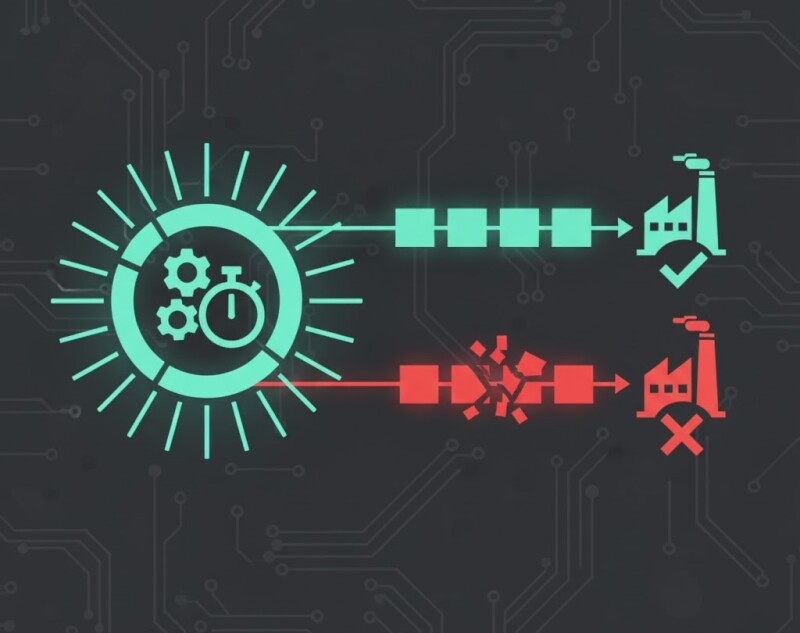
TSN brings determinism to Ethernet — but not magic. Engineers must understand what TSN can truly guarantee, and where the physical layer, firmware, and application stack still introduce uncertainty.
What TSN Guarantees
- Bounded latency: Each class of traffic has a maximum delay window.
- Synchronization: Nodes share a common clock via IEEE 802.1AS (PTP).
- Predictability: Deterministic scheduling eliminates packet collisions.
What TSN Doesn’t Guarantee
- Application determinism: Software tasks can still delay message handling.
- Physical anomalies: Cable noise, switch firmware, or EM interference can still drop packets.
- End-device latency: PLC or drive firmware must handle frames deterministically, too.
Layered Determinism
Real determinism is a system property. TSN provides the foundation, but the control stack — PLC task scheduling, firmware timing, and OS priorities — must align to achieve microsecond-level guarantees.
Case Example
An automotive plant moved from EtherCAT to TSN-based Ethernet. While network latency stayed below 10 µs, application task jitter at the PLC layer added ±4 µs. After CPU pinning and task prioritization, the full system met target sync thresholds.
Related Articles
- TSN 101 for Controls Engineers: Time Sync and Queues
- Lab Testing TSN: Tooling, Traffic, and KPIs
- Migrating Motion Control to TSN: A Stepwise Plan
Conclusion
TSN guarantees the network — not the application. When paired with real-time firmware and synchronized tasks, Ethernet finally becomes predictable enough for motion and machine control.














Interested? Submit your enquiry using the form below:
Only available for registered users. Sign In to your account or register here.