


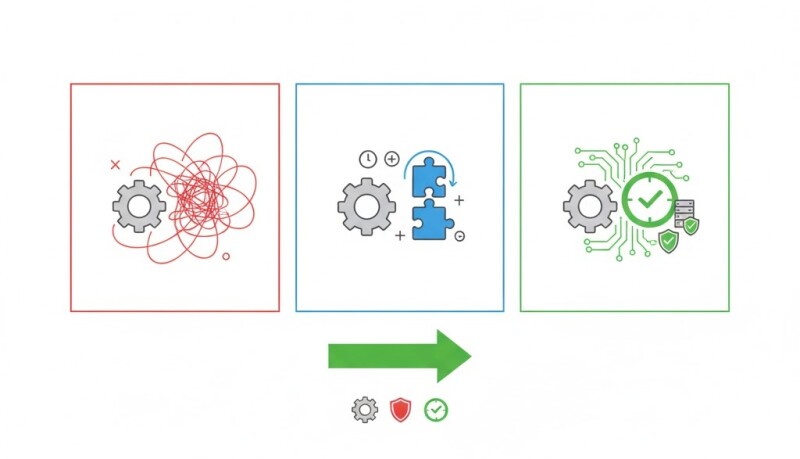
Migrating Motion Control to TSN: A Stepwise Plan
Moving from proprietary motion networks (EtherCAT, SERCOS, PROFINET IRT) to TSN-based motion control can unlock interoperability and reduce vendor lock-in. But migration must be methodical — balancing performance, safety, and downtime.
Step 1 – Assess Legacy Architecture
Map all real-time motion nodes, update rates, and synchronization mechanisms. Identify what’s proprietary (e.g., master clocks, frame formats) versus standard (Ethernet PHYs, UDP).
Step 2 – Establish a TSN Test Cell
Set up a pilot line with mixed devices — TSN drives, PLCs, and I/O modules — to validate interoperability and timing. Use PTP trace tools to confirm synchronization within ±1 µs.
Step 3 – Implement Dual-Network Transition
Run legacy motion and TSN in parallel during commissioning. Use gateways or protocol bridges to allow gradual device replacement without halting production.
Step 4 – Optimize Scheduling and QoS
Apply 802.1Qbv schedules and verify that time-critical traffic occupies dedicated windows. Tune queue configurations for motion control class streams.
Case Example
A packaging machine builder replaced an EtherCAT backbone with TSN + OPC UA PubSub. Migration occurred in three stages over six weeks with zero unscheduled downtime and equivalent motion performance.
Related Articles
- Lab Testing TSN: Tooling, Traffic, and KPIs
- Determinism over Ethernet: What TSN Guarantees (and Doesn’t)
- TSN + OPC UA PubSub: Reference Architectures
Conclusion
TSN migration isn’t a rip-and-replace project — it’s an evolution. With parallel testing and traffic tuning, factories can modernize motion control without losing a beat.














Interested? Submit your enquiry using the form below:
Only available for registered users. Sign In to your account or register here.