


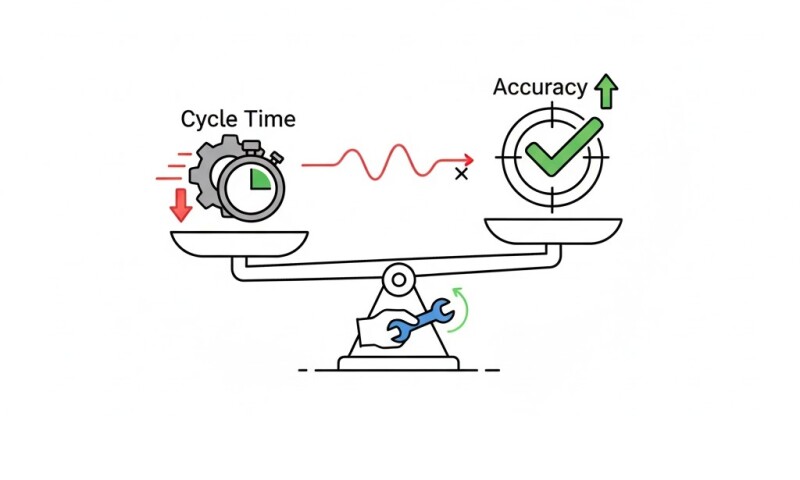
Cycle Time vs Accuracy: Tuning Trade-Offs
In 3D bin picking, faster isn’t always better. Every millisecond saved in cycle time risks reduced positional accuracy and higher reject rates. The art lies in finding the optimal trade-off between speed and precision — tuned for your specific parts, sensors, and motion system.
Understanding the Trade-Off
Shorter cycle times require simplified vision pipelines and faster trajectory planning. But if camera exposure or robot stabilization is too short, the result is mispicks or part collisions.
Parameters to Balance
- Vision latency: Lower exposure = faster refresh, lower accuracy.
- Robot acceleration: High speed may induce vibration and positional drift.
- Trajectory smoothing: Polynomial motion reduces jerk at minimal cost in speed.
Adaptive Tuning Techniques
- Use AI to predict success probability before each pick and adjust motion aggressiveness dynamically.
- Optimize PLC scan cycles and sensor fusion to eliminate redundant waits.
- Implement soft real-time scheduling for multi-threaded pick cycles.
Case Example: Forged Part Handling
After tuning exposure and acceleration parameters, one integrator achieved a 20% reduction in cycle time with no loss in success rate — translating to an extra 50 parts/hour per cell.
Related Articles
- 3D Bin Picking That Works: Vision, Motion, and Grippers
- Force-Torque Sensing for Delicate Handling
- From Sim to Shop Floor: Commissioning Bin-Picking Cells
Conclusion
Cycle time and accuracy don’t have to compete — they can coexist. With feedback-driven tuning and adaptive planning, robotic bin-picking achieves both speed and precision at industrial scale.












Interested? Submit your enquiry using the form below:
Only available for registered users. Sign In to your account or register here.