




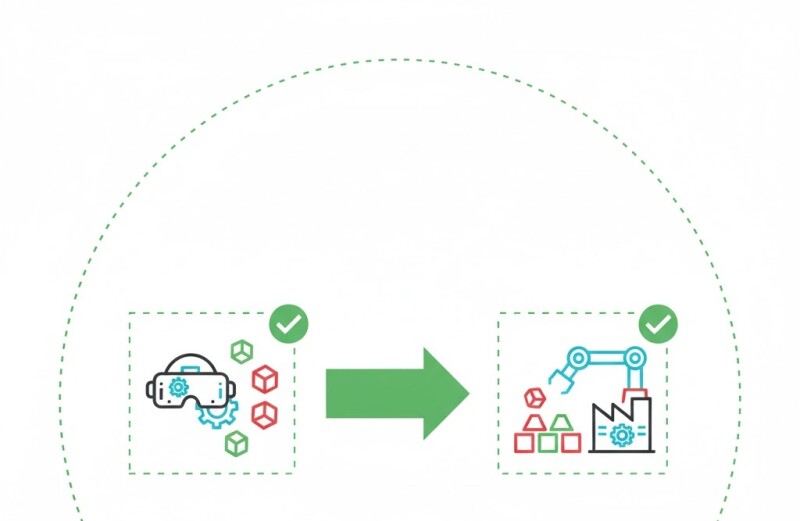
From Sim to Shop Floor: Commissioning Bin-Picking Cells
Simulation-to-production workflows have become essential in robotic bin-picking projects. A digital twin enables engineers to validate cell layout, motion paths, and sensor placement before any hardware is powered on — cutting commissioning time by weeks.
Why Simulate First
- Detect collisions and blind spots early.
- Pre-train AI vision models on synthetic point clouds.
- Estimate achievable cycle times before purchasing hardware.
Digital Twin Workflow
- Step 1: Import CAD and bin geometries into the simulation platform.
- Step 2: Integrate robot kinematics and 3D vision models.
- Step 3: Run virtual picks, then export motion profiles to the real controller.
Commissioning Acceleration
Modern systems sync simulation and live telemetry. Engineers test new trajectories virtually, then deploy safely through soft-start modes — achieving “virtual commissioning” loops in under 15 minutes.
Case Example: Tier-2 Supplier Deployment
A bin-picking cell went from CAD to production in 19 days, using digital twin validation and pre-trained vision models. Physical debugging time was cut by 60%.
Related Articles
- 3D Bin Picking That Works: Vision, Motion, and Grippers
- Path Planning for Random Bins: Practical Tips
- Cycle Time vs Accuracy: Tuning Trade-Offs
Conclusion
Simulation is now the first commissioning step, not the last. When digital twins guide setup, 3D bin-picking systems reach production faster, safer, and with predictable results.











Interested? Submit your enquiry using the form below:
Only available for registered users. Sign In to your account or register here.