





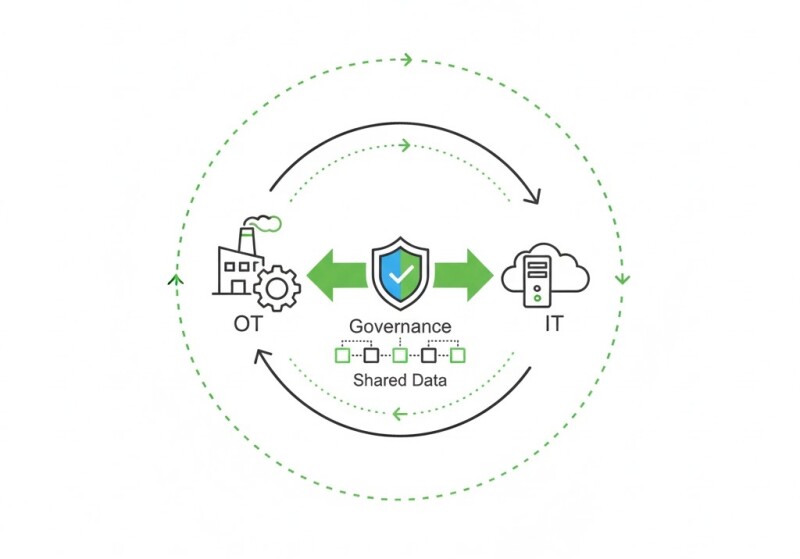
Bridging OT and IT: Governance for Shared Data
Operational Technology (OT) and Information Technology (IT) have historically worked in silos — one focusing on uptime, the other on data access. As organizations converge under Unified Namespace (UNS) architectures, shared data governance becomes a strategic necessity.
The Governance Gap
OT teams control process data with strict reliability constraints. IT manages data analytics, cloud, and security. Without coordination, mismatched priorities lead to duplication, latency, and compliance risks.
Core Elements of OT–IT Governance
- Common taxonomy: Shared naming conventions and data models across systems.
- Access control layers: IT defines policies; OT enforces them locally.
- Joint change management: Every modification to the UNS structure reviewed by both teams.
- Data quality KPIs: Define measurable standards for accuracy, latency, and completeness.
Governance in Practice
Establish a Data Council composed of OT engineers, IT architects, and operations leaders. Meet monthly to review namespace evolution, incident logs, and integration roadmaps.
Case Example: Food & Beverage Company
After forming an OT–IT governance board, the company eliminated redundant data pipelines and reduced integration rework by 45%. Cyber and compliance audits also became significantly faster.
Related Articles
- Data Ownership in OT: Who Owns What, and Why It Matters
- Designing a Plant-Wide Data Model That Scales
- How to Avoid Creating a New Data Silo with Your UNS
Conclusion
Bridging OT and IT is not a technical project — it’s a governance discipline. Clear roles, shared definitions, and joint oversight turn your UNS from a data experiment into a sustainable enterprise backbone.









Interested? Submit your enquiry using the form below:
Only available for registered users. Sign In to your account or register here.