


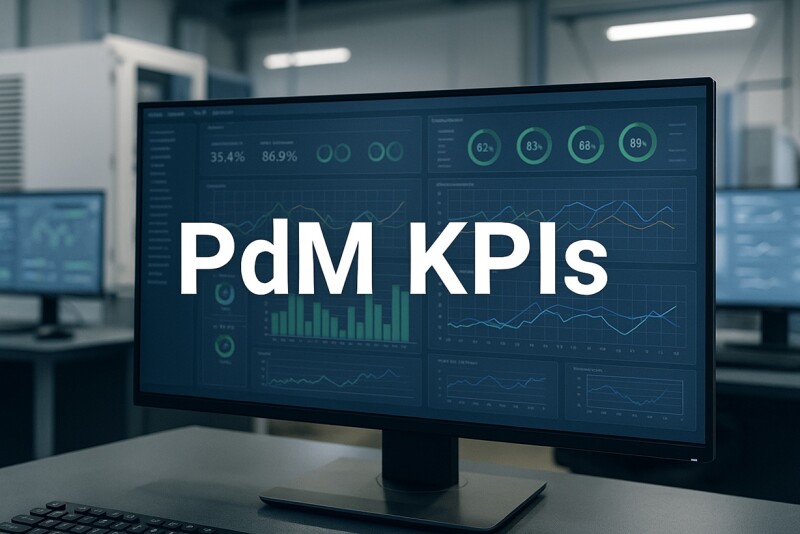
5 KPIs That Prove Your PdM Program Works (and 3 That Don’t)
Every plant claims to be “data-driven,” but few can prove that predictive maintenance (PdM) is paying off. Without disciplined KPIs, PdM becomes a collection of dashboards and anecdotes. This guide identifies the five metrics that truly demonstrate impact—and three that often mislead decision-makers.
Why Measurement Matters
Maintenance executives must justify sensor budgets and data-science headcount. The only way to do that credibly is through metrics that connect condition monitoring to availability, cost avoidance, and risk reduction. The KPIs below link technical performance to financial results, closing the gap between engineering and finance.
✅ The 5 KPIs That Actually Matter
1. Mean Time Between Failures (MTBF)
MTBF remains the gold standard for reliability. A sustained increase after PdM rollout proves earlier detection and fewer unplanned stoppages. Track it per critical asset and normalize by operating hours to remove load bias.
2. Unplanned Downtime Reduction
Downtime costs are visible to management. Compare rolling 12-month averages before and after PdM adoption. A 20-40 % drop is typical when vibration and thermal analytics are deployed on top assets. Cross-validate with production and CMMS logs for credibility.
3. Maintenance Cost per Operating Hour
This KPI combines repair, labor, and parts costs against production output. Predictive programs that catch faults early reduce expensive emergency repairs and weekend overtime. A consistent downward trend confirms true savings—not deferred maintenance.
4. Alert Precision and Recall
AI-based PdM must prove signal quality. Precision = True Positives / (All Alerts). Recall = True Positives / (All Actual Failures). High precision means less “cry-wolf”; high recall means you’re not missing real faults. These numbers tie directly to operator trust.
5. Lead Time to Failure (LTTF)
LTTF measures the average time between the first anomaly detection and the verified intervention. The longer the warning window, the greater the scheduling flexibility. Best-in-class PdM systems deliver 5-10 days of actionable lead time for rotating equipment.
⚠️ The 3 KPIs That Mislead
1. Number of Sensors Installed
Sensor counts don’t equal insight. Without coverage planning, plants often overspend on non-critical assets. Focus on risk-weighted coverage—criticality × failure probability × detectability.
2. Data Volume Collected
Terabytes of data prove nothing unless converted into timely decisions. More isn’t better if the architecture can’t support model retraining or alert validation. Optimize data quality, not quantity.
3. Dashboard Views or “User Logins”
Engagement metrics look good in presentations but don’t measure reliability improvement. The best PdM dashboards run quietly—surfacing only when something meaningful happens.
How to Operationalize the Good KPIs
Build KPI tracking directly into your maintenance workflow:
- CMMS integration: Each alert links to a work order with “predicted” or “unpredicted” outcome codes.
- Automated tagging: Edge agents attach model and threshold versions to every event.
- Weekly governance: Reliability engineers review false positives/negatives and update thresholds accordingly.
- Monthly financial roll-up: Convert downtime saved into €/$ value for management reports.
Example ROI Snapshot
A packaging line with ten critical motors implemented vibration-based PdM. After six months:
- Unplanned downtime ↓ 32 %
- MTBF ↑ 28 %
- Maintenance cost/hour ↓ 17 %
- Alert precision = 93 %, recall = 88 %
The annualized ROI reached 3.6× the total program cost. This is the language executives understand.
Connecting KPIs to Continuous Improvement
Effective programs link PdM KPIs to lean and Six Sigma initiatives. MTBF and downtime feed OEE, while precision and recall feed data-science metrics. Aligning these ensures reliability and analytics teams chase the same outcome: measurable availability gains.
Q&A: Common Confusions
How often should KPIs be updated?
Weekly for technical indicators (precision/recall), monthly for financials (downtime cost). Annual reviews support capital planning.
What’s the best visualization?
Trend lines with control limits and automatic annotations for model or process changes. Avoid single-point gauges—they hide trends.
Should KPI targets be absolute or relative?
Relative improvements are more defensible. Aim for percentage changes versus the pre-PdM baseline rather than arbitrary thresholds.
Related Articles
- Predictive Maintenance in 2025: Sensors, Signals, and Real ROI
- Anomaly Detection 101 for Rotating Equipment: From Vibration to Vision
- MLOps for OT: Versioning, Drift, and Model Monitoring on the Edge
Conclusion
Not all metrics prove success. The five KPIs above link directly to reliability and cost impact, while the misleading ones only track activity. When you report MTBF, unplanned downtime reduction, cost/hour, alert quality, and lead time, your PdM program earns trust—and budget—to expand sustainably.













Interested? Submit your enquiry using the form below:
Only available for registered users. Sign In to your account or register here.