


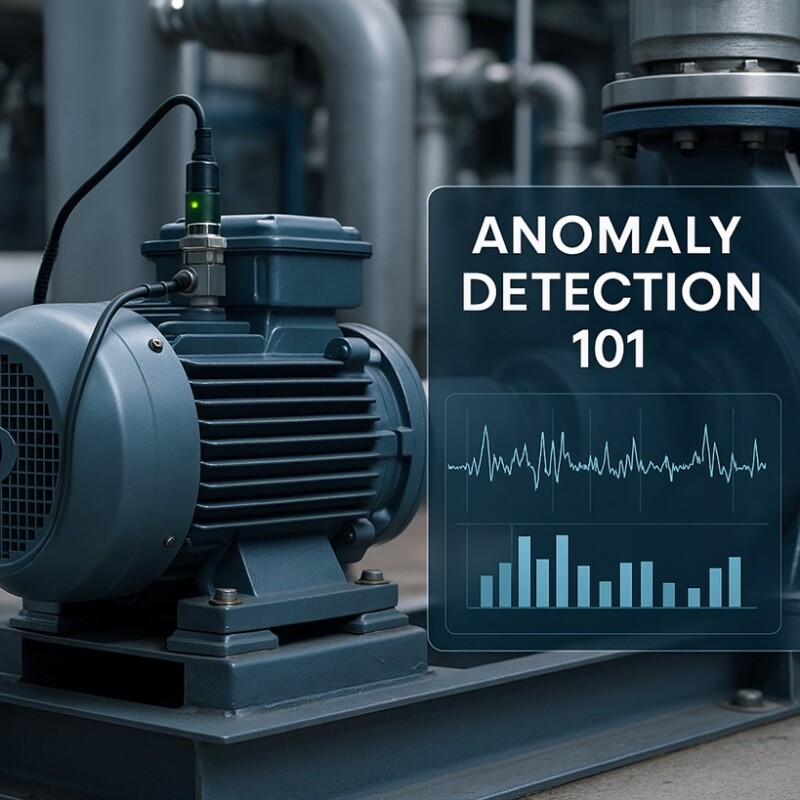
Anomaly Detection 101 for Rotating Equipment: From Vibration to Vision
Industrial assets like pumps, motors, and compressors rarely fail without warning — but the early signs hide inside signals, spectra, and sometimes images. Anomaly detection finds those deviations before they become downtime, blending vibration analytics with modern AI. This guide explains how to move from traditional condition monitoring to AI-driven anomaly detection that works reliably on the edge.
Why Anomaly Detection Matters
In rotating equipment, faults evolve gradually: a small imbalance today becomes bearing damage tomorrow. Manual trending can miss weak signals or human fatigue. Automated anomaly detection enables continuous surveillance of machines, flagging deviations early enough to plan maintenance without overreacting to noise.
While Predictive Maintenance 2025 focuses on ROI and deployment, this article dives into the algorithms and signals that make PdM actionable.
Signal Sources for Rotating Equipment
Most anomaly detection starts with vibration — but cross-sensor fusion strengthens reliability:
- Vibration: Triaxial accelerometers (up to 10 kHz) detect imbalance, misalignment, and bearing wear.
- Acoustic emission: High-frequency sensors (20–100 kHz) reveal early-stage defects before vibration rises.
- Motor current signature: Captures electrical anomalies in rotors and stators.
- Thermal / infrared: Indicates lubrication or loading issues.
- Visual inspection: Cameras detect leaks, surface cracks, and abnormal motion using edge-deployed AI.
From Thresholds to Machine Learning
Classic monitoring uses fixed thresholds — if vibration RMS exceeds X, raise an alarm. This approach is simple but brittle. Anomaly detection replaces hard limits with statistical or learned baselines:
- Statistical control: Mean ±3σ or exponentially weighted moving average (EWMA) on key features.
- Multivariate models: PCA or Mahalanobis distance to capture correlated behavior between sensors.
- Unsupervised learning: Autoencoders, isolation forests, or one-class SVMs trained only on healthy data.
- Hybrid ML + physics: Combine bearing defect frequencies (BPFO, BPFI) with ML residual monitoring.
These methods allow continuous learning of “normal” behavior and adaptive thresholds tuned to each asset’s pattern.
Feature Engineering Still Matters
Even in AI-driven workflows, features remain the bridge between physics and data science:
- Time-domain: RMS, kurtosis, skewness, crest factor.
- Frequency-domain: FFT magnitudes at bearing and gear mesh orders.
- Envelope spectrum: Demodulated high-frequency band energy for early defects.
- Time–frequency: Wavelet transforms or spectrograms capture transient events.
Feature vectors feed anomaly scores that are trended over time. Edge devices can compute these in milliseconds, allowing on-site decisions.
Deploying Anomaly Detection at the Edge
Running inference on the edge minimizes latency and ensures resilience when the network is down. The architecture typically includes:
- Sensor front-end: Accelerometer + A/D interface sampling deterministically at 5–20 kHz.
- Edge compute: Small industrial gateway or embedded GPU running pre-trained model.
- Data bus: OPC UA or MQTT streaming summary metrics to central historian or cloud.
- Model management: Controlled rollouts and drift monitoring, as detailed in MLOps for OT.
Interpreting the Anomaly Score
Raw anomaly scores mean little without context. Convert them into meaningful maintenance tiers:
- Normal (0–0.4): Within learned baseline variation.
- Warning (0.4–0.7): Persistent deviation; plan inspection or lubrication.
- Critical (0.7–1.0): Consistent outlier; schedule controlled stop or confirm via secondary sensor.
Display these tiers clearly on the HMI and log them in your CMMS with timestamps and model version IDs for traceability.
Adding Vision to the Mix
Vibration isn’t the only anomaly channel. High-speed cameras now detect blade cracks, belt slippage, or leaks using AI-based vision. Edge cameras paired with compact models can identify motion irregularities or heat signatures. Vision-based anomaly detection complements traditional sensors by seeing what vibration can’t.
Case Example: Fan Bearing Anomaly
A packaging plant installed triaxial accelerometers on 60 conveyor fans. Over three months, a PCA-based anomaly model flagged slow drift in kurtosis and peak amplitude. Maintenance verified grease degradation — a planned re-lubrication avoided unplanned downtime worth €18,000. Retraining incorporated temperature compensation, reducing false positives by 40%.
Common Pitfalls
- Noise = anomaly: Don’t confuse process variation with faults. Normalize by load and speed.
- Data starvation: Collect enough healthy data before training — at least 2–3 weeks of stable operation.
- Drift blindness: Models age. Schedule retraining every 3–6 months or after process changes.
- Alert fatigue: Merge redundant alarms; use confidence and persistence rules.
KPIs for Anomaly Detection
- Precision/Recall: Percentage of true vs false alarms.
- Lead Time: Average hours between first anomaly flag and actual intervention.
- Coverage: Ratio of assets with active monitoring vs total.
- Drift MTTR: Time from drift detection to retrained deployment.
Lightweight Q&A
Can anomaly detection work without labeled failures?
Yes — unsupervised or semi-supervised models learn normal behavior and flag deviations automatically. Labeling only refines them later.
Is AI required?
Not always. For single-sensor monitoring, simple statistical control often beats complex models if the data quality is high.
What’s the ROI timeline?
Most plants see measurable reduction in unplanned downtime within 3–6 months, especially when tied to existing PdM or CMMS workflows.
Related Articles
- Predictive Maintenance in 2025: Sensors, Signals, and Real ROI
- MLOps for OT: Versioning, Drift, and Model Monitoring on the Edge
- OPC UA over TSN Explained: Determinism Without Vendor Lock-In
Conclusion
Anomaly detection bridges the gap between traditional condition monitoring and full predictive maintenance. By combining vibration, acoustics, current, and vision, engineers gain a holistic view of equipment health. Deployed on the edge with proper versioning and monitoring, these systems turn raw signals into actionable foresight — protecting uptime and extending asset life.













Interested? Submit your enquiry using the form below:
Only available for registered users. Sign In to your account or register here.