


Voice Interfaces in Noisy Plants: What Actually Works
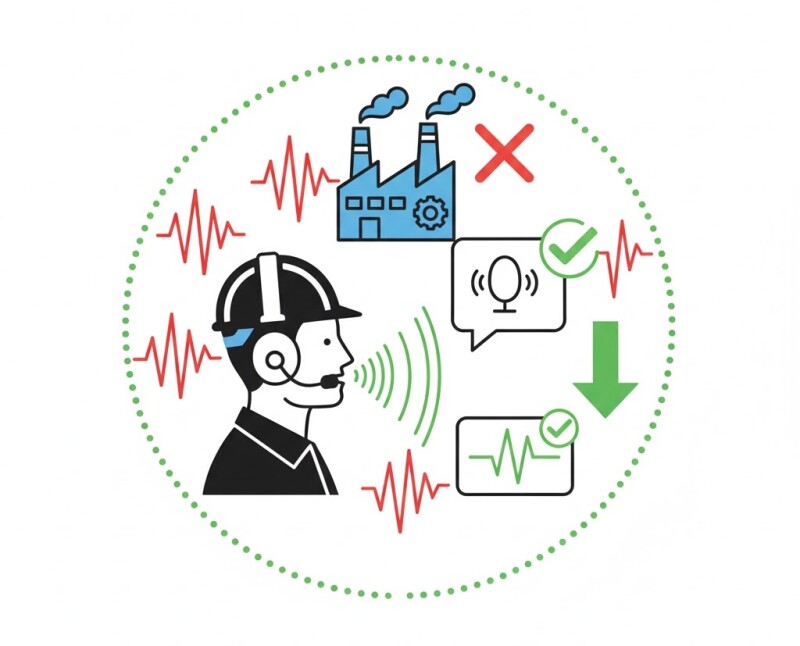
Speech-to-text interfaces promise hands-free assistance for maintenance teams — but factories are loud. Implementing voice-enabled copilots in real industrial environments requires specialized design and hardware.
Key Challenges
- Ambient noise from motors and air systems can exceed 90 dB.
- Standard microphones misinterpret commands or generate false triggers.
- Technicians wear PPE (ear protection, masks) that muffle speech.
Proven Design Strategies
- Use beamforming headsets and noise-canceling microphones.
- Implement keyword activation (“Hey Copilot”) with local buffering.
- Run ASR (Automatic Speech Recognition) at the edge to reduce latency.
Case Example
A packaging plant integrated an offline voice copilot with its CMMS. Even in 88 dB environments, command recognition exceeded 94% accuracy after microphone array tuning.
Related Articles
- LLM Copilots for Technicians: From Manuals to Moments of Need
- RAG for OT: Building a Safe Knowledge Base for Maintenance
- Audit Trails for AI Copilots: Proving Who Saw What
Conclusion
Voice copilots only succeed when the interface is tuned for industrial acoustics. The technology is ready — if implemented with hardware-aware AI and edge processing.













Interested? Submit your enquiry using the form below:
Only available for registered users. Sign In to your account or register here.