


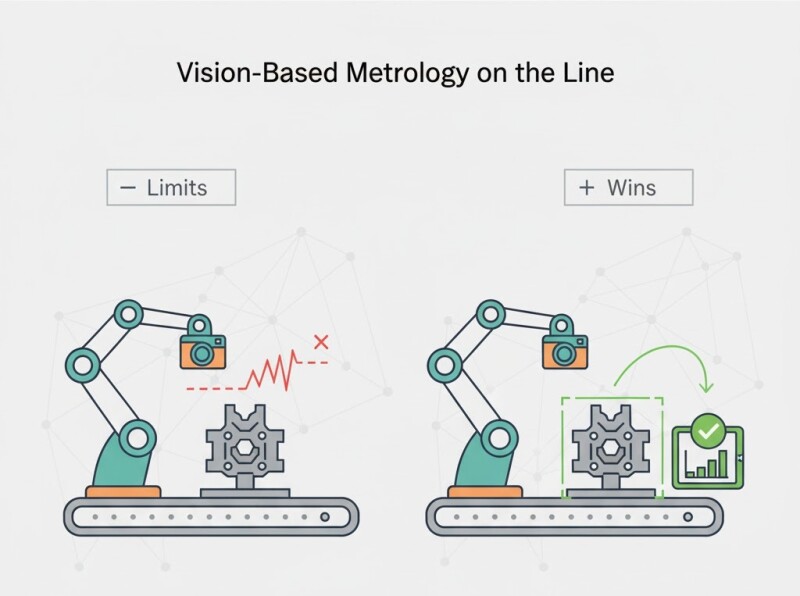
Vision-Based Metrology on the Line: Limits and Wins
Inline metrology powered by vision systems enables 100% inspection at production speed. But while accuracy keeps improving, limitations remain in lighting, depth accuracy, and calibration stability.
1. Advantages of Vision Metrology
- Speed: Non-contact measurement in milliseconds.
- Coverage: Measures every part, not samples.
- Integration: Connects directly to PLCs or MES for pass/fail logic.
2. Key Challenges
- Thermal drift and lens distortion affecting micron-level accuracy.
- Reflective or transparent surfaces requiring polarization and structured light.
- Need for stable calibration artifacts and automatic re-zero routines.
3. Hybrid Approaches
Combining 2D vision, laser triangulation, and photogrammetry achieves balance between precision and speed. Many systems now use AI-based defect classification with embedded geometric checks.
Example
A precision plastics plant implemented inline vision metrology for connector pins. Throughput rose 25% while maintaining ±5 μm repeatability.
Related Articles
- Automating Calibration: Schedules, Sensors, and Sign-Offs
- SPC Meets Metrology: Close the Loop on Quality
- Reducing Measurement Uncertainty with Better Motion
Conclusion
Vision-based metrology delivers fast, automated measurement — but still demands careful lighting, calibration, and motion control. Used well, it bridges the gap between inspection and quality assurance.














Interested? Submit your enquiry using the form below:
Only available for registered users. Sign In to your account or register here.